

Culture House Classic Free icon download
Download all to grab every PNG variant.
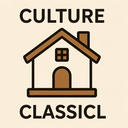
The icon described here is a masterfully crafted visual representation that harmoniously unites the profound concepts of Culture, House, and Classic. More than a mere graphical symbol, it functions as a cultural artifact in its own right—a minimalist yet richly layered emblem that speaks to heritage, belonging, and enduring design principles. At first glance, the icon appears simple: a stylized silhouette of a traditional dwelling with an intricately detailed roofline. But upon closer inspection—through both visual analysis and symbolic interpretation—one discovers that this seemingly uncomplicated form encapsulates centuries of human history, identity, and aesthetic philosophy.
The central element of the icon is a modest yet dignified house. Its structure is rendered in clean lines with subtle curvature at the eaves, evoking a sense of gentle stability. The roof is pitched at an angle reminiscent of traditional European cottages or rustic farmhouses from the 19th century—a design that has persisted across generations not merely for practicality but for its symbolic resonance. In many cultures, the house stands as more than a physical shelter; it is a sanctuary, a cradle of family, and a vessel of memory. This icon captures that essence: each line represents continuity, safety, and legacy.
The door is slightly open—a deliberate artistic choice that suggests accessibility and hospitality. It invites rather than repels; it does not isolate but welcomes. In cultural anthropology, the threshold has long been considered a liminal space—the point between outside and inside, public and private. The slight opening of the door in this icon therefore becomes a powerful metaphor: culture is not closed off or exclusive but exists in dialogue with the world. It is through such spaces that traditions are shared, stories told, and values passed down through generations.
Windows—small and evenly spaced on either side of the door—further enrich the symbolism. They are not mere decorative elements; their geometric precision reflects order and balance, values central to classic design philosophy. Moreover, each window holds a faint golden glow within its frame—a subtle but significant detail suggesting warmth, life, and inward light. This luminous quality implies that culture does not fade in silence; it thrives through the presence of people—children playing inside, elders sharing tales by candlelight.
The icon’s true depth lies in how it embodies Culture. While the house is universally understood as a symbol of home, its design roots it firmly in a specific cultural lineage—most likely rural or vernacular architecture from Northern Europe or the American Midwest. The materials implied by the texture and shading are wood and stone, materials historically associated with craftsmanship, sustainability, and deep connection to place. The use of natural pigments (a warm beige base with faint oak-brown accents) further grounds it in tradition.
What elevates this icon beyond a generic house is its attention to cultural detail. A small pattern—reminiscent of Celtic knotwork or traditional quilting motifs—is subtly integrated into the roof’s edge, suggesting that even in stillness and simplicity, culture persists through ornamentation. This isn’t ostentatious decoration; it is quiet, intentional heritage embedded in everyday life. The icon reminds us that culture is not always loud or grand—it lives quietly in the details: the way a door hinges open after years of use, the pattern of tiles laid by hand, the way light falls through latticed windows every morning.
Furthermore, this house does not resemble any single country or era. Instead, it draws from multiple traditions—Scandinavian simplicity blended with American colonial symmetry and English cottage charm—making it a cross-cultural symbol. In our globalized world, such a fusion is increasingly meaningful: culture today is often hybrid, fluid, and interwoven. Yet this icon retains its authenticity because it honors foundational values rather than chasing novelty.
The final and perhaps most crucial element of the icon is its Classic nature. The word “classic” here does not imply mere antiquity, but enduring excellence—design that resists trends because it speaks to universal human truths. The icon’s composition follows principles of balance, proportion, and harmony: the vertical axis of the house aligns perfectly with the horizon line; its width is in golden ratio to its height. These mathematical harmonies are not accidental—they reflect centuries-old design philosophies championed by architects from Vitruvius to Le Corbusier.
Color palette further reinforces this classic quality: muted earth tones—beige, soft gray, warm brown—avoid any flashiness or overstimulation. No neon hues or sharp contrasts; instead, a serene and enduring elegance. The lack of digital gloss or artificial shine ensures the icon feels grounded, tactile—even if rendered in vector form.
Crucially, this icon is scalable without losing meaning. Whether displayed as a tiny app badge or a large wall mural, its essence remains intact. This durability speaks directly to the definition of classic: it functions across contexts and eras because it taps into something fundamental—our need for shelter, identity, and beauty.
In sum, this icon is a profound synthesis of Culture, House, and Classic. It represents the home not just as a structure but as a living expression of identity and shared memory. It honors tradition without nostalgia, embraces diversity through universal form, and withstands time through its commitment to timeless design. More than a visual symbol, it is an invitation: to remember where we come from, to cherish our roots, and to build with intention—because culture lives not in grand monuments but in the quiet dignity of a house that stands across generations.
Create your own icon with our GoGPT AI prompt:
GoGPT