

Culture Medical cross Tribal Free icon download
Download all to grab every PNG variant.
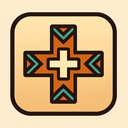
At first glance, this icon appears as a complex fusion of ancient symbolism and modern medical imagery. Yet upon deeper examination, it reveals itself as a profound representation of interconnected human experiences—where heritage meets healing, where tradition intersects with science. At its core lies the universal symbol of medicine: the medical cross, traditionally recognized as a signifier of healthcare, compassion, and the pursuit of wellness across civilizations. But this is no ordinary medical cross. It is not rendered in sterile white or clinical blue; instead, it emerges from a deeply textured backdrop rooted in tribal artistry—a fusion that speaks to the enduring legacy of indigenous knowledge systems and their vital role in holistic health.
The icon's central element—the medical cross—is elegantly stylized. Rather than the conventional four equal arms, this version features an asymmetrical, dynamic form where each limb is subtly elongated and intricately patterned. The vertical arm extends with a sense of upward motion, symbolizing hope and the aspiration toward recovery. The horizontal arms stretch outward like roots or outstretched hands, suggesting connection—between healer and patient, between communities and care providers. Each arm terminates in a stylized tribal motif: geometric patterns reminiscent of those found in West African Adinkra symbols, Maori koru spirals, Native American beadwork designs, and Andean weaving traditions. These elements are not mere ornamentation; they carry encoded meanings—protection, renewal, balance, and spiritual wholeness.
Surrounding the cross is a circular border composed of interlocking tribal motifs that form a mandala-like structure. This ring represents the cyclical nature of life, health, and community. The design draws inspiration from indigenous cultures worldwide: from the sacred geometry of Navajo sand paintings to the symbolic patterns in Yoruba cloth, and even to Polynesian tattoo art that encodes genealogical narratives. The circle itself is a powerful emblem across tribal traditions—a symbol of unity, continuity, and the eternal journey of life. By framing the medical cross with this circular tapestry of cultural expression, the icon asserts that healing does not exist in isolation from culture; rather, it thrives within cultural context.
Color plays a crucial role in conveying meaning. The medical cross is rendered in deep indigo and forest green—colors traditionally associated with spiritual insight (indigo) and natural balance (green). These hues are not random choices but deliberate references to the earth-based philosophies of many tribal societies, where health is seen as an equilibrium between body, mind, spirit, and environment. The cross's arms subtly fade into gold at their extremities—symbolizing enlightenment, wisdom passed through generations. This golden accent also echoes the sacred use of gold in ritual objects across diverse cultures: from Celtic torcs to Incan ceremonial masks.
Within the central intersection of the cross, a small but powerful image is embedded—a stylized human figure in a meditative stance, carved with tribal symmetry. The figure’s posture invokes ancient healing practices found in shamanic traditions around the world. This representation challenges modern medical dogma by emphasizing that wellness is not solely physical but deeply psychological and spiritual. It reflects the reality that many indigenous communities have long practiced integrative medicine—using herbal remedies, energy work, ancestral wisdom, and communal support as essential components of healing.
The icon’s overall composition is both harmonious and intentionally provocative. It resists simplistic categorization by refusing to separate "traditional" from "modern," "spiritual" from "scientific." Instead, it suggests that true healing—especially in multicultural societies or under-resourced communities—requires a synthesis of these worlds. The medical cross, often seen as a symbol of Western biomedicine, is re-imagined not as an imposition but as an invitation: to listen to indigenous knowledge systems and integrate them into broader healthcare frameworks.
This icon holds particular resonance in contemporary global health discourse. As institutions increasingly recognize the importance of cultural competency in medicine, this design serves as a visual manifesto. It speaks to healthcare providers, policymakers, and communities alike: effective care must honor the cultural identities of patients. The tribal elements remind us that healing is deeply personal and collective—rooted in stories, rituals, land, language. The medical cross reminds us of scientific rigor and ethical responsibility.
In essence, this icon is not just a graphic—it is a statement. It embodies the belief that culture is medicine and medicine can be cultural. By merging the medical cross with rich tribal artistry, it affirms that healing transcends borders and binaries. It celebrates diversity as a source of strength, wisdom as something passed down through generations, and health as a sacred journey shared by all humanity.
This is more than an icon. It is a living symbol of unity in diversity—where ancient traditions nurture modern care, where science listens to the stories of the land and its people. In its intricate design lies a powerful truth: healing begins when we honor both the cross and the circle—the tools of medicine and the wisdom of culture.
Create your own icon with our GoGPT AI prompt:
GoGPT