

Culture Train Flat design Free icon download
Download all to grab every PNG variant.
In the realm of modern digital design, icons have evolved from simple visual markers into powerful symbolic representations that convey complex ideas with minimal visual noise. Among these, an icon that seamlessly blends the themes of Culture, Train, and Flat Design stands as a compelling example of how contemporary graphic design can communicate depth, movement, and meaning through simplicity. This particular icon captures the essence of cultural exploration through transit—where the journey is as significant as the destination—and achieves this through a meticulous application of flat design principles.
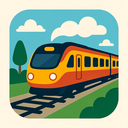
The icon begins with its core subject: a train. At first glance, it appears to be a streamlined locomotive, rendered in clean geometric shapes that are characteristic of flat design. Unlike traditional illustrations that rely on gradients, shadows, and intricate textures to suggest depth and realism, this train is composed of bold outlines and solid color blocks. The engine car is shaped with sharp angles—reminiscent of a futuristic metro or high-speed rail vehicle—while maintaining a sense of approachability through its rounded edges. Its body features a horizontal white stripe running along the central axis, symbolizing modernity and efficiency, while the front end includes two large, circular headlights rendered in solid yellow, suggesting energy and forward motion. The wheels are depicted as simple circles with radial spokes—minimal yet highly recognizable—and placed symmetrically beneath the train to convey balance and stability.
But this is no ordinary train. It is not merely a symbol of transportation; it is a vessel of Culture. To emphasize this thematic depth, subtle cultural elements are incorporated into the design without disrupting its flat aesthetic. The sides of the train are adorned with stylized patterns inspired by traditional textile art from various global regions—such as African kente cloth motifs, Japanese shibori dyeing patterns, and Andean weaving designs—each rendered in thin line art using a single bold color (typically deep navy or burnt orange) to maintain visual harmony. These patterns are not overwhelming; instead, they serve as quiet reminders of the diverse human expressions that travel through time and space. They suggest that every journey on this train carries within it stories, languages, music, food traditions, and historical narratives.
The train’s roof is uniquely shaped: a gentle upward curve at the front end evokes a sense of ascent—both literal (as in climbing mountains or rising above urban landscapes) and metaphorical (representing personal growth and cultural enlightenment). On this curved roof sits a small, stylized dome reminiscent of architectural elements found in historic train stations across Europe, India, or South America. This dome is not detailed with textures or shading; rather, it’s a flat polygonal shape filled with a soft gradient that transitions subtly from white to light beige—a nod to aged stone and time-worn brickwork. This design choice reinforces the idea that trains are not only modern machines but also carriers of heritage and architectural legacy.
Even the train’s windows reflect cultural significance. They are depicted as rectangular cutouts with a slight inward bevel (a subtle visual cue within flat design), each containing a miniature scene rendered in vector form: one window shows hands exchanging traditional crafts, another displays dancers in colorful costumes from different continents, and yet another illustrates ancient script or calligraphy. These scenes are not literal depictions but abstracted representations—simplified to match the icon’s overall flat style. Each is colored using a muted palette (terracotta, sage green, indigo) so as not to distract from the dominant color scheme of the train itself.
The Flat Design approach is central to this icon’s success. Every element adheres strictly to the principles of minimalism: no gradients beyond subtle transitions for depth, no drop shadows or outlines that break visual consistency, and a limited color palette—typically composed of primary colors (blue, yellow, red), neutral greys, and earth tones—to ensure scalability and readability across devices. The entire icon is created using vector graphics, allowing it to be resized without loss of quality—a necessity in today’s responsive digital environments. Furthermore, the use of uniform line weights (e.g., 2px for outlines) ensures visual rhythm and balance.
When viewed on a smartphone screen or embedded into an app interface, this icon communicates instantly: it speaks of movement, connection, and discovery. It suggests that travel—whether physical or metaphorical—can be a bridge between cultures. The train becomes more than machinery; it transforms into a cultural conduit, carrying not just passengers but also the collective memory and artistic spirit of nations.
In essence, this icon is a triumph of design philosophy: by integrating Culture through symbolic patterns and meaningful scenes, expressing Train as both a functional object and an emotional journey, and grounding it all in the clarity and elegance of Flat Design, it becomes more than an image—it becomes a metaphor for global understanding. It invites users to think beyond transportation: to consider how movement shapes identity, how stories are shared across borders, and how simplicity can hold profound meaning.
This icon doesn’t just represent a train carrying people; it represents the human desire to connect—to learn, to grow, and to celebrate our shared yet diverse world—one flat design at a time.
Create your own icon with our GoGPT AI prompt:
GoGPT