

Environment Drone Retro Free icon download
Download all to grab every PNG variant.
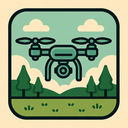
In a world increasingly defined by technological advancement and environmental consciousness, the concept of an icon that seamlessly fuses "Environment," "Drone," and "Retro" emerges not as a mere design exercise, but as a profound visual metaphor for our era’s complex relationship with innovation and sustainability. This meticulously crafted icon transcends conventional symbolism, weaving together three powerful themes into a single, evocative image that speaks to both nostalgia and future-forward thinking.
The central figure of the icon is a retro-styled drone—its form inspired by 1960s and 1970s science fiction illustrations and early conceptual designs from the golden age of aerospace. The drone’s body is shaped like an elongated teardrop with gently rounded edges, reminiscent of vintage flying saucers or the imagined aircraft in classic comic books such as those from *Flash Gordon* or *The Jetsons*. Its proportions are balanced and elegant, not overly technical or futuristic—instead, it exudes a charm that feels both timeless and whimsical.
The drone is rendered in a palette of earth-toned colors: soft sage green for its fuselage, with accents of warm rust orange on the undercarriage and brushed copper highlights on its propulsion rings. These hues are carefully selected to evoke nature while simultaneously suggesting mechanical craftsmanship. The color scheme subtly signals a harmonious coexistence between technology and the natural world—a visual promise that even our machines can be part of environmental stewardship.
Its design incorporates distinct retro elements: a prominent circular lens at the front resembling an old-fashioned camera or observatory glass, with visible grooves in the metal frame and a small, exposed filament-style light bulb embedded within it. This feature is not just aesthetic—it serves as a symbolic eye for observation. The drone’s rotors are positioned symmetrically around its midsection like the blades of a vintage windmill or early helicopter models from the 1950s, but they are made of translucent green plastic with a subtle glowing glow—suggesting clean energy operation. Instead of loud, modern electric motors, these rotors appear to spin silently on air currents or gentle solar propulsion.
The environment is not merely a backdrop—it is an active participant in the icon’s narrative. The drone hovers above a stylized landscape that blends pastoral serenity with subtle technological integration. In the foreground lies a lush forest rendered in soft, watercolor-like gradients: deep emerald trees, winding streams with reflective surfaces, and vibrant wildflowers blooming beneath a sky of gentle blue and soft white clouds. Yet interwoven within this natural scenery are organic-looking mechanical elements—solar panels shaped like leaves, wind turbines disguised as tree trunks with rotating blades that mimic the motion of swaying branches.
The drone itself is not depicted as a surveillance tool or invasive machine. Instead, it appears to be actively monitoring and nurturing the environment. A subtle trail of green light pulses gently from its underside—like a digital raindrop falling into the landscape—symbolizing data collection for ecological preservation. Tiny icons resembling pollinators (bees, butterflies) drift upward from the forest floor toward the drone’s sensors, suggesting that this machine is not replacing nature but collaborating with it. In fact, one of its rotors carries a small seed pod dispenser at its tip—evidence that this drone is also involved in reforestation and ecological restoration.
The overall visual language of the icon leans heavily into retro design principles. The lines are clean but not overly sharp; they possess a hand-drawn quality with slight imperfections that give the piece authenticity. The background uses a faded parchment texture, reminiscent of old technical schematics or vintage travel posters from mid-century environmental movements. A subtle grain overlay and soft vignetting evoke the feel of an aged photograph—something you might find in an antique science journal from 1968.
Even the typography used to label this icon—should it be accompanied by text—is styled in a retro-futuristic font reminiscent of 1970s sci-fi movie titles: bold, slightly rounded, with a hand-lettered feel. The word "ECOFLY" might appear beneath the image in this font, combining "eco" (environment) with "fly" (drone), creating a brandable yet meaningful fusion.
At its core, this icon is more than a symbol—it’s a philosophy. It tells the story of how our past fascination with flying machines and space exploration can be reimagined not as tools of conquest or consumption, but as instruments of protection and renewal. The retro aesthetic isn’t just nostalgic; it’s intentional. It reminds us that innovation doesn't always have to mean cold, impersonal technology. Sometimes, the most advanced solutions are the ones that look like they belong in a dream from 50 years ago—beautifully simple, human-centered, and kind to the planet.
In an age where environmental degradation and technological alienation often go hand-in-hand, this icon stands as a hopeful vision: that drones—those modern marvels of engineering—can be redesigned with nature at their heart. And in doing so, they become not just tools of observation, but guardians of the Earth. Through its fusion of retro charm and ecological purpose, this icon becomes a timeless emblem for sustainable innovation—one that looks back to appreciate the past while flying forward toward a greener tomorrow.
Create your own icon with our GoGPT AI prompt:
GoGPT