

Environment Factory Retro Free icon download
Download all to grab every PNG variant.
```html
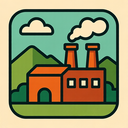
The icon in question is a masterful synthesis of three distinct yet interconnected themes: Environment, Factory, and Retro. At first glance, it appears as a nostalgic symbol from the mid-20th century—a vintage aesthetic that evokes the design sensibilities of the 1950s and 1960s—but upon closer inspection, its deeper meaning unfolds through an intricate balance between industrial heritage and ecological awareness.
The icon's foundation is a retro-inspired visual language. It features bold, clean lines reminiscent of mid-century modern design, with rounded edges on all elements to soften the mechanical appearance. The color palette draws from the past: a warm chrome silver for metal components, mustard yellow for accents, and a muted forest green that suggests both nature and time-worn patina. The overall effect is one of classic industrial charm—like an old factory blueprint or an era-defining advertisement poster from the postwar boom years.
Centered in the icon is a stylized factory building with three prominent smokestacks, but these are not typical representations. Instead of belching dark, polluting plumes into a gray sky, each smokestack emits swirling patterns of light green and sky blue mist that resemble blooming flowers or gentle clouds. The transformation from pollution to purity symbolizes the modern reimagining of industrial spaces through sustainable practices. This visual paradox is central to the icon’s message: industry does not have to be at odds with nature; it can coexist in harmony.
The factory itself has a retro design motif—the rounded roofline, symmetrical windows, and large double-doors with decorative metal grills that evoke early 20th-century industrial architecture. However, subtle modern touches disrupt the nostalgia: solar panels are installed on the rooftop in perfect geometric alignment (a stark contrast to vintage designs), and vertical wind turbines sit gracefully beside two of the smokestacks. These renewable energy features are rendered in a retro-futuristic style—rounded, slightly cartoonish, yet technically accurate—blending whimsy with purpose.
Surrounding the factory is a carefully composed natural environment. A lush border of stylized trees and shrubs encircles the structure, their leaves shaped like abstract polygons to maintain visual consistency with the icon’s geometric style. At ground level, green grass grows in a checkerboard pattern—another nod to retro design—but with each square representing different types of sustainable vegetation: clover for soil health, dandelions for resilience, and wildflowers that attract pollinators. The earth beneath is not bare or industrial; instead, it's painted with subtle textures resembling rich topsoil.
Adding to the icon’s layered storytelling are small retro details that reinforce its dual identity. A vintage-style factory whistle sits atop one of the smokestacks, but its sound is not a harsh alarm—it’s shaped like a musical note, suggesting harmony instead of urgency. In front of the main entrance, there's a classic wooden bench with red vinyl seats—common in mid-century public spaces—but it’s embedded with tiny LED lights that glow softly when activated by motion (a subtle touch of modern eco-tech). A vintage delivery truck with fender skirts and whitewall tires is parked nearby, but its engine emits not exhaust—it's charging a small electric battery, indicated by blue light pulses from the hood.
The background of the icon features a soft gradient sky that transitions from pale yellow at the horizon (mimicking dawn) to deep blue above. Floating in this sky are subtle cloud shapes made of recycled paper texture—each one resembling a small factory blueprint or architectural sketch. This serves as an elegant metaphor: our future industrial landscapes can be built from ideas and materials that come full circle, closing the loop on waste.
Even the icon’s edges have intentional design choices. The outer frame is a thick, slightly cracked border of what appears to be weathered brick—symbolizing both endurance and deterioration—but upon closer inspection, the cracks are filled with vibrant ivy growing through them. This reinforces the theme that nature reclaims industrial ruins when given a chance, but also that human innovation can guide this regeneration.
Ultimately, this icon is more than a symbol—it’s a narrative. It tells the story of how we can honor our industrial past while embracing sustainable futures. The retro aesthetic makes it instantly recognizable and emotionally resonant; the factory elements ground it in reality; and the environmental integration transforms it into an optimistic vision of progress. This is not a nostalgic longing for bygone eras, but a thoughtful invitation: to build factories that breathe like forests, to create industry that dances with nature, and to imagine progress through the lens of both memory and hope.
Through this harmonious fusion of Environment, Factory, and Retro, the icon stands as a beacon—not just for design excellence, but for a deeper truth: sustainability is not a departure from our past; it’s its most thoughtful evolution.
```Create your own icon with our GoGPT AI prompt:
GoGPT