

Environment House Tribal Free icon download
Download all to grab every PNG variant.
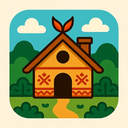
The icon described by the keywords "Environment," "House," and "Tribal" is not merely a visual symbol—it is a profound representation of humanity’s deepest relationship with nature, community, and ancestral heritage. At its core, this icon weaves together three fundamental aspects of human existence: our responsibility to the natural world (Environment), our need for shelter and belonging (House), and our cultural identity rooted in traditions passed down through generations (Tribal). When these elements converge in a single design, they create an emblem of balance, resilience, and sustainable living that speaks across time and culture. Visually, the icon depicts a circular or oval-shaped composition—symbolizing unity, wholeness, and the cyclical nature of life. At its center stands a stylized house constructed from natural materials: woven bamboo beams forming an arched roof that curves gracefully like a protective hand over the earth. The walls are made of interlocking clay bricks with subtle textures resembling hand-carved patterns found in indigenous architecture around the world—particularly in West African, Amazonian, and Pacific Islander communities. The house is not isolated; it is rooted into the ground through thick tree roots that extend downward like veins, symbolizing deep connection to the land. From this central structure rise four slender but strong tree trunks, each representing a cardinal direction (north, south, east, west)—a common motif in many tribal cosmologies. These trees are not ordinary; they bear leaves shaped like hands and eyes—symbolizing nature’s awareness and guardianship of human life. The canopy forms a living roof over the house itself, with vines gently draped from branch to branch like protective curtains. Birds perch on the uppermost branches, their wings spread as if in flight toward the sky—a reminder that harmony with nature means freedom not just for humans but for all living beings. Surrounding the house and trees is a ring of stylized patterns inspired by traditional tribal art: geometric motifs reminiscent of those used by Native American, Maori, or San peoples. These patterns are not decorative; they carry meaning. Intricate lines form river-like pathways that flow from the base of the house upward into the roots—representing water cycles, life-giving currents that sustain both land and people. Other shapes mimic footprints in sand or soil—evidence of continuous human presence over generations, a testament to enduring habitation on ancestral lands. The color palette is earth-toned and spiritually grounded: deep browns for the house frame and soil; mossy greens for vegetation; terracotta reds for clay walls and ceremonial markings. Accents of ochre yellow represent sunlight breaking through the canopy, while faint blue swirls near the base symbolize underground water sources—essential to life in many tribal communities. The entire icon is rendered with soft gradients, giving it a warm, organic feel that invites touch and reflection. Crucially, this icon embodies the concept of "Environment" not as a distant or abstract idea but as an intimate partner in daily life. Every element—from the materials used to construct the house to the flora surrounding it—reflects sustainable practices. The house is designed for natural ventilation and passive solar heating, with open-air courtyards allowing breezes to flow freely. Rainwater is collected via rooftop channels into carved stone basins near the entrance, echoing ancient systems still used by tribal cultures worldwide. This visual language reinforces that true environmental stewardship is not about sacrifice but about living in alignment with nature’s rhythms. The "House" aspect of the icon extends beyond physical shelter to represent safety, identity, and continuity. In many tribal societies, the home is more than a structure—it is the heart of community life. It hosts ceremonies, storytelling sessions, and communal meals where wisdom is passed from elders to youth. The circular layout of this icon reflects that notion: there are no corners or boundaries; everyone belongs. The open doorway invites visitors not as outsiders but as kin—reinforcing the idea that true homes are inclusive spaces built on mutual care. Finally, the "Tribal" element grounds the entire design in cultural authenticity and ancestral memory. The patterns, materials, and symbolic forms are drawn from real indigenous traditions across continents. Yet rather than copying any single culture verbatim, this icon synthesizes universal themes found in tribal worldviews: reverence for elders, respect for nature spirits, cyclical timekeeping (as opposed to linear progression), and collective decision-making. The inclusion of symbolic animals—such as a small jaguar curled beneath the house or an eagle soaring above—further emphasizes spiritual interconnectedness. These are not mere decorations; they are archetypes that represent values like courage, vision, and protection. In essence, this icon stands as a modern manifesto for ecological and cultural sustainability. It reminds us that our homes should be in harmony with the environment, not against it; that community—our tribal bonds—must remain strong in an age of isolation; and that ancestral wisdom holds answers to the challenges of climate change, displacement, and cultural erosion. By uniting Environment, House, and Tribal into one cohesive visual narrative, this icon transcends mere design—it becomes a call to action: live simply. Live responsibly. Remember who you are—and where you come from. In a world increasingly fragmented by technology and urbanization, this symbol offers a quiet but powerful reminder: the path to true sustainability begins not with machines or policies, but with returning to the wisdom of the earth, our homes, and our shared human heritage.
Create your own icon with our GoGPT AI prompt:
GoGPT