

Environment Satellite Classic Free icon download
Download all to grab every PNG variant.
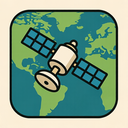
The icon in question is a meticulously crafted representation that masterfully blends the themes of Environment, Satellite, and Classic. Designed with both aesthetic elegance and symbolic depth in mind, it serves as a visual metaphor for humanity's enduring connection to Earth, our technological reach into space, and the timeless values embedded in traditional design. Each element of this icon is intentional, layered with meaning, and constructed to evoke a sense of reverence for nature while celebrating human innovation.
At its core lies a stylized Earth, depicted as a smooth, globe-like sphere rendered in classic 2D vector art. The Earth is not merely a blue-and-green orb but an intricate tapestry of natural features: sweeping continents, defined coastlines, and gently curving mountain ranges. The coloring is carefully chosen—deep cerulean blues for the oceans contrast with vibrant greens for forests, warm ochres for deserts, and subtle whites representing polar ice caps. These hues are not overly saturated; rather, they are soft and timeless in tone, reminiscent of mid-20th-century cartographic illustrations. This classic approach to color selection grounds the icon in a heritage of visual storytelling that predates digital design but remains influential today.
Hovering above this Earth is a stylized Satellite, elegantly suspended in orbit. The satellite is not rendered with modern, high-tech angularity, but instead adopts a rounded, symmetrical form—reminiscent of early Cold War-era space probes like Explorer 1 or the Soviet Sputnik. Its body is a perfect silver sphere with delicate arms extending outward at precise angles: two solar panels that curve gracefully like wings and an antenna that extends upward in a gentle arc. The satellite's surface reflects light subtly, suggesting a polished metallic finish with no sharp edges or jagged lines—this soft luminosity enhances the classic aesthetic while symbolizing both technological progress and harmony with nature.
The orbit path of the satellite is not drawn as a rigid circle but as a softly curved, continuous line in muted silver—almost like a delicate thread of light encircling the planet. This fluid trajectory reinforces the idea that satellite technology does not dominate or disrupt Earth but rather moves in peaceful coexistence with it. The orbital design echoes vintage astronomical diagrams from classic science textbooks and 1950s educational films, where celestial mechanics were illustrated with clarity and grace. This choice of design language connects the icon to a nostalgic era of scientific wonder while maintaining relevance for modern audiences.
Crucially, the satellite is not positioned high above Earth in isolation—it subtly overlaps the equatorial region of the planet, as if in communion rather than surveillance. This detail underscores a deeper message: technology must serve and protect the Environment. The satellite's purpose is not conquest or observation for exploitation but monitoring and safeguarding. It symbolizes environmental satellites used today—such as NASA’s Landsat or ESA’s Sentinel series—that track deforestation, monitor climate change, measure sea level rise, and assess air quality. By integrating this function into the icon's design, it becomes more than a visual symbol; it becomes a call to action.
The Classic aspect of the icon is evident in every line and curve. The overall composition adheres to principles of balance, symmetry, and proportion—hallmarks of traditional design from the Renaissance through mid-century modernism. The absence of sharp gradients or neon colors ensures that the icon remains timeless rather than fleeting. Instead, it draws upon a legacy of simplicity and elegance seen in vintage postage stamps, early space posters by artists like Chesley Bonestell, and classic logo design from companies like IBM and Pan Am. This deliberate nod to heritage gives the icon a sense of permanence: it feels as if it could have been created decades ago but still belongs in today’s digital world.
In terms of visual hierarchy, the Earth is slightly larger than the satellite, establishing it as the central focus—the foundation of all life and action. The satellite orbits with grace and purpose, not dominance. Together, they form a dynamic yet peaceful system: a classic representation of humanity's relationship with technology and nature. There are no aggressive angles or dystopian overtones; instead, there is optimism—an assurance that innovation can coexist with preservation.
When viewed at various sizes—whether as a small app icon on a smartphone or scaled up for use in print materials—the icon remains legible and impactful. Its clean lines and balanced composition ensure it retains its integrity across formats. The classic design philosophy guarantees that it will not quickly become outdated, while the environmental symbolism ensures its relevance in an era defined by climate awareness.
In conclusion, this icon is a profound synthesis of three powerful concepts: Environment—celebrating Earth's beauty and fragility; Satellite—honoring human ingenuity and our reach into space; and Classic—embodying timeless design principles that transcend trends. It is not merely a graphic but a narrative: a reminder that our greatest achievements in technology must always serve the greater good of the planet, guided by wisdom, balance, and reverence for nature.
Create your own icon with our GoGPT AI prompt:
GoGPT