

Environment Train Digital glitch Free icon download
Download all to grab every PNG variant.
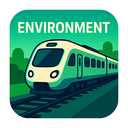
The icon presents a visually striking and conceptually rich composition that masterfully weaves together three distinct yet interconnected themes: Environment, Train, and Digital Glitch. This hybrid symbol serves as a powerful visual metaphor for the evolving relationship between modern technological infrastructure, sustainable transportation, and the environmental consequences of digitalization. At first glance, it appears to be a stylized train silhouette set against a landscape that suggests both natural ecosystems and artificial systems—this duality is reinforced through deliberate design choices that incorporate elements of digital decay and data corruption. The central figure is a high-speed electric train, rendered in clean geometric lines with subtle gradients to convey motion and efficiency. The train’s streamlined body, reminiscent of eco-conscious maglev or bullet train designs, emphasizes sustainability—a clear nod to green transportation solutions. Its sleek form suggests speed without the emissions associated with fossil-fueled alternatives. The roofline features a faint solar panel motif subtly integrated into the architecture, symbolizing renewable energy use in transit infrastructure. This visual cue reinforces the environmental message: that modern mobility can be both fast and ecologically responsible. But what truly sets this icon apart is how it destabilizes this harmonious vision with the presence of Digital Glitch effects. Running across the train’s body like a fractured data stream are jagged, pixelated lines that appear to tear through its surface. These glitches mimic corrupted digital signals—think of static interference, chromatic aberrations, or fragmented pixels—as if the train’s digital control system is under stress. The glitching effect doesn't merely decorate; it disrupts the train’s form in a way that suggests vulnerability in technology-driven systems. The background further deepens this narrative. It merges two contrasting worlds: on one side, lush green forests with winding rivers and trees rendered in soft gradients, symbolizing natural ecosystems; on the other side, abstract circuit patterns and glowing grid lines that resemble data networks or server farms. The boundary between these two realms is blurred—trees grow out of digital matrices, while wires spiral through root systems like neural pathways. This fusion illustrates how technology is now deeply embedded in the environment—not just alongside it but within it. The glitch effects extend beyond the train itself. Particles of corrupted data float through the air like digital pollen, some forming temporary shapes that resemble leaves or smoke before dissolving into static noise. The wheels of the train leave behind a trail that flickers between smooth motion and abrupt digital disintegration—sometimes showing a clean path forward, other times revealing fragmented remnants of past positions. This visual metaphor suggests uncertainty in our reliance on technology: while trains represent progress and sustainability, the glitches remind us that systems can fail or become unstable when faced with data corruption, cyberattacks, or poor infrastructure resilience. Color plays a crucial role in conveying meaning. The environment side uses cool greens and blues—symbolizing life, water, and air—while the digital elements are rendered in electric purples, neon pinks, and sharp whites that contrast with the organic tones. However, these colors frequently bleed into one another at the point of intersection: green pixels glitch into pink static; blue circuit lines flicker with emerald artifacts. This chromatic collision visually embodies the tension between nature and technology—how they can coexist but also threaten each other. Even in its smallest details, every element speaks to the three core themes. The windows of the train are partially obscured by digital noise, revealing glimpses of passengers whose faces are either pixelated or replaced with abstract data patterns. This suggests not just a technological system in motion but one that affects human experience—our identities and interactions mediated through digital interfaces. Meanwhile, the tracks themselves are designed to resemble binary code when viewed from a distance, subtly reinforcing the idea that transportation infrastructure is increasingly governed by algorithms and automation. The icon’s overall composition balances order and chaos. The train moves forward with purpose—a symbol of progress—but its form is repeatedly fractured by glitch effects that imply systemic fragility. This tension reflects contemporary debates about sustainable development: can we achieve environmental goals through technological innovation, or does the very infrastructure we rely on to solve ecological crises also contribute to new forms of digital pollution and risk? In conclusion, this icon is not merely a decorative symbol; it is a narrative device. It captures the complex reality of modern life—where green transportation like high-speed electric trains offers hope for environmental sustainability, but where our reliance on interconnected digital systems introduces new vulnerabilities. The Digital Glitch elements are not flaws in the design but intentional statements: they represent the unpredictable nature of technology, its potential to disrupt ecological balance if not properly governed. Through this layered visual language, the icon invites viewers to reflect on how innovation must be balanced with responsibility—both for our planet and for the digital networks that now shape every aspect of our lives.
Create your own icon with our GoGPT AI prompt:
GoGPT