

Finance Credit card Digital glitch – Free icon download
Download all to grab every PNG variant.
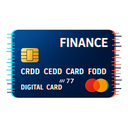
In the rapidly evolving landscape of modern commerce and personal finance, the convergence of traditional financial systems with digital technology has given rise to a new visual symbol—one that encapsulates complexity, vulnerability, and innovation. This icon is not merely an aesthetic representation; it is a narrative-rich metaphor that integrates three powerful and interdependent elements: Finance, Credit Card, and Digital Glitch. Each component plays a distinct yet inseparable role in shaping the icon’s meaning, both literally and symbolically.
The foundation of this icon is rooted in the realm of Finance. Finance is not just about transactions or numbers—it represents trust, stability, risk assessment, economic flow, and accountability. The icon begins with a clean yet structured design reminiscent of financial charts—think subtle lines resembling stock trends or pie charts subtly embedded within its form. These elements are rendered in neutral tones such as deep blues and greys to evoke professionalism and reliability. However, beneath this surface calm lies an undercurrent of tension—a sense that the financial world is increasingly vulnerable to disruption, not from external forces alone, but from internal digital instability.
Embedded within the finance structure is a stylized Credit Card, which serves as both a central symbol and a point of conflict. The credit card is depicted in a slightly distorted yet recognizable form—its rounded corners softened into an angular wave, its stripes fragmented. This visual transformation reflects how credit cards have evolved from simple plastic instruments into digital gateways for global transactions. It represents the transition from physical to virtual financial tools, where trust is no longer placed solely in a tangible object but in encrypted data and real-time processing systems. The card’s logo—typically a bold brand mark—is subtly blurred or pixelated, suggesting that even familiar financial icons can become ambiguous in the digital age.
Crucially, the Digital Glitch is not an afterthought. It is the defining dynamic of this icon and acts as both a visual disruption and a conceptual force. A subtle wave of jagged lines, static noise, or pixelation appears across the credit card portion—spreading like interference through digital circuits. These glitches are not random; they follow patterns reminiscent of corrupted data streams or failed API calls. In places where the card’s number sequence would be expected (e.g., the last four digits), fragmented numbers appear, sometimes forming incorrect sequences or repeating characters—an unmistakable visual metaphor for transaction errors, identity theft risks, and data breaches. The glitch may ripple outward to touch other parts of the finance structure—distorting charts, causing lines to flicker or jump in value—thereby illustrating how a single point of failure can cascade across entire financial systems.
This icon is not intended to represent a negative experience alone. Rather, it reflects the duality inherent in modern finance: while digital tools offer unprecedented convenience and efficiency, they simultaneously introduce new vulnerabilities. The glitch does not destroy the integrity of the system—it merely reveals it. It becomes a mirror held up to users, reminding them that behind every seamless transaction is a fragile chain of code, servers, and human oversight. In this sense, the Digital Glitch becomes both a warning and an opportunity for reflection.
Furthermore, the interaction between these three elements creates psychological depth. When viewed closely, one notices that the glitch does not appear chaotic—it follows a rhythmic pattern, almost like a heartbeat or signal pulse. This suggests that digital systems are not inherently broken; they are operating under stress conditions—high volume, real-time processing demands, or cyber threats. The glitch becomes a form of visual rhythm, signaling that the system is active and responsive—even if imperfect.
The color scheme of the icon supports this layered narrative. Cool blues dominate the finance base, symbolizing trust and professionalism. However, where glitches occur—especially in the credit card region—the colors shift to muted reds and purples, indicating urgency or instability. These hues do not scream alarm; they whisper concern, much like early warning signs in a financial dashboard.
Additionally, this icon serves as a cautionary tale for consumers and businesses alike. It reminds users that when using digital credit card platforms—such as mobile payment apps, online shopping sites, or automated banking services—their personal data and financial information are not immune to technical errors or malicious manipulation. The glitch symbolizes both technological limitations and human fallibility in system design.
From a design standpoint, the icon balances complexity with clarity. It does not overwhelm the viewer with excessive detail but instead uses symbolic language to communicate abstract ideas. The fusion of finance, credit card, and digital glitch is intentional—not just for visual appeal but to provoke thought about transparency, security, and resilience in financial technology.
Ultimately, this icon stands as a modern emblem of our digital economy. It acknowledges that while financial systems have become faster and more accessible thanks to technology, they remain susceptible to unforeseen disruptions. The presence of the Digital Glitch is not an error—it is a necessary acknowledgment of reality. In a world where every transaction lives in code and data, this icon reminds us that behind every successful payment lies a fragile network of trust, innovation, and potential failure.
In summary, this icon transcends mere illustration. It functions as a dynamic symbol—where Finance provides the framework, Credit Card offers the focal point of human interaction with money, and Digital Glitch introduces a critical layer of vulnerability and awareness. Together, they form a powerful visual narrative about the current state of global finance in the digital era—an era defined not just by progress, but by perpetual tension between convenience and risk.
Create your own icon with our GoGPT AI prompt:
GoGPT