

Food Tree Pixel art – Free icon download
Download all to grab every PNG variant.
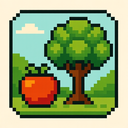
At the heart of digital aesthetics lies a unique fusion of nature, nourishment, and visual simplicity—the iconic representation known as the "Food, Tree, and Pixel Art" icon. This carefully crafted digital emblem is a harmonious blend of three essential elements: food, tree, and pixel art. Each component serves not only as a visual motif but also as a symbolic narrative that speaks to the relationship between nature, sustenance, and modern design principles.
At the core of this icon stands a stylized tree, rendered in clean, geometric forms that reflect the precision and clarity characteristic of pixel art. The tree is not merely an ornamental backdrop—it is a representation of growth, life cycles, and environmental balance. Each branch emerges from a central trunk composed of square-shaped pixels arranged in ascending tiers, giving the structure a strong sense of upward movement and natural progression. The leaves are meticulously crafted using small, evenly spaced pixel blocks that form clusters resembling foliage—each leaf being a distinct unit within the grid-based aesthetic.
The tree’s design follows the principles of minimalist pixel art, where every element contributes to visual coherence. The trunk is typically formed from vertical columns of solid pixels, creating a sturdy foundation that anchors the entire composition. Branches extend diagonally and horizontally in a branching pattern reminiscent of real-world trees, but simplified so that they maintain perfect alignment with pixel grid lines—ensuring symmetry and clarity even at small scales.
What makes this tree particularly significant is its connection to food. In many cultures, trees are symbolic of nourishment—beeches provide edible nuts, fruit-bearing trees offer sustenance, and forest ecosystems support biodiversity essential for food security. By placing the tree at the center of the icon, the design emphasizes nature’s role as a source of life and food. The visual weight of the tree gives it prominence in both composition and meaning.
Surrounding or growing from various parts of the tree are representations of food—specifically, fruit, vegetables, seeds, and grains—all rendered with pixel art precision. These elements do not appear randomly; they are thoughtfully placed to reflect natural growth patterns. For example, clusters of red and yellow pixels form ripe fruit hanging from lower branches—apples or citrus-like forms that mimic real-world produce but are composed entirely of square blocks.
Other food items such as a small bundle of pixelated wheat sprouting from the base of the trunk or a cluster of green vegetables arranged in vertical strips represent agricultural origins. These food elements are not only visually engaging but also serve an educational purpose, subtly reminding viewers that sustainable food systems rely on healthy ecosystems—especially forests and trees.
Each piece of food is carefully designed to respect pixel art boundaries. The colors used are limited to a palette typically seen in retro-style graphics—such as bright greens, warm yellows, soft oranges, and muted reds—to maintain a nostalgic yet accessible look. These color choices not only enhance visual appeal but also create emotional connections with the viewer; green evokes growth and health, while vibrant reds symbolize freshness and energy.
Moreover, the food elements are distributed across different levels of the tree: some hang low for accessibility (representing staple foods), others grow high in symbolic terms (indicating future or seasonal produce). This hierarchical structure reflects how nature organizes nourishment—some food sources are immediate, while others require time and patience.
The entire icon is conceived within the framework of pixel art—a digital art style that uses discrete square pixels to create images. This technique, popularized in early video games and retro design, brings a sense of nostalgia, clarity, and visual charm. In this particular icon, pixel art is not just a stylistic choice—it is foundational to its identity.
Every line of the tree’s trunk and every fruit on its branches adheres strictly to pixel boundaries. There are no gradients or smooth curves—only sharp edges and defined blocks. This creates a digital authenticity that gives the icon a timeless quality, making it instantly recognizable across platforms, devices, and age groups.
The use of pixel art in this context also serves as a commentary on modernity’s relationship with nature. In an age dominated by digital interfaces and high-resolution graphics, the pixel art style acts as a deliberate return to simplicity. It highlights that even within technological environments, we can still express deep ecological values through accessible, elegant design.
Additionally, pixel art allows for scalability without loss of detail. The icon remains legible and meaningful whether displayed on a smartphone screen or in a large digital dashboard. This adaptability makes it highly functional in both user interfaces and educational tools aimed at teaching children about food systems and environmental sustainability.
Beyond its aesthetic appeal, this icon carries significant symbolic weight. It represents a bridge between the natural world and human needs—showing how trees produce food through photosynthesis, pollination, and fruiting. The fusion of these three elements creates a powerful message: sustainable living begins with respecting nature’s cycles.
It can be used in various contexts—from environmental education apps to healthy eating campaigns—to visually communicate the importance of preserving forests and supporting plant-based diets. Its simplicity ensures that even young children or individuals unfamiliar with complex ecological concepts can understand its meaning at a glance.
Furthermore, by using pixel art, the icon maintains an inclusive design language that transcends cultural barriers. It is universally recognizable regardless of language or region, making it an ideal tool for global outreach in environmental and health initiatives.
In summary, the "Food, Tree, and Pixel Art" icon is far more than a simple visual symbol—it is a carefully composed narrative of growth, nourishment, and human connection to nature. Through the precise execution of pixel art techniques, it elevates the tree from a mere background element into a central figure. The integration of food sources provides practical relevance and educational value, while maintaining an accessible and engaging design that resonates with diverse audiences. This icon stands as a testament to how digital aesthetics can serve meaningful social and ecological purposes—proving that even in the world of pixels, we can grow real things.
Create your own icon with our GoGPT AI prompt:
GoGPT