

Gaming Bridge Digital glitch Free icon download
Download all to grab every PNG variant.
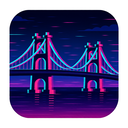
The icon is a meticulously crafted digital artifact that embodies the dynamic fusion of three seemingly disparate concepts—Gaming, Bridge, and Digital Glitch—into a single cohesive visual narrative. At first glance, the icon appears to be an abstract representation of digital connectivity and virtual interactivity; upon closer inspection, it reveals layers of meaning that speak to identity in the hyper-connected age. The central motif is a stylized bridge constructed not from stone or steel but from luminous data streams and fragmented digital particles. This bridge spans a chasm of pixelated chaos, symbolizing the divide between physical reality and virtual existence. Its structure is both fragile and resilient—a paradox that mirrors the experience of modern gamers who traverse countless digital worlds yet remain tethered to their real-world identities. The arches of the bridge are formed from jagged, neon-lit circuit pathways reminiscent of neural networks or quantum connections, glowing with electric blue, acid green, and deep violet hues. These colors pulse faintly in rhythmic intervals—subtle animations that suggest a living digital ecosystem. At the apex of the bridge stands a stylized gaming controller icon rendered in 3D depth with reflective surfaces. The controller is not fully intact; instead, its faceplate is fractured along geometric lines, revealing glitching internal circuitry beneath. This intentional imperfection represents the theme of "Digital Glitch" as both an aesthetic and philosophical statement. The glitch effects aren't random—each distortion follows a pattern akin to corrupted code or data corruption in a video game environment. Particles of digital noise drift from the cracks like ghostly sparks, forming ephemeral shapes: fragments of health bars, paused screens, or fragmented player avatars mid-action. The bridge itself is not perfectly symmetrical. One side leans slightly downward with a jagged edge that appears to have been torn from a higher-resolution world into this lower-quality digital space—visually evoking the experience of game loading screens or screen tearing effects common in high-intensity gaming scenarios. The ground beneath the bridge is composed of shattered hexagonal tiles, reminiscent of classic arcade-style grid layouts. Embedded within these tiles are tiny icons: miniature representations of video game genres—platformers, shooters, RPGs—each flickering as if struggling to render properly. The background is a gradient field transitioning from deep cosmic black to electric indigo with subtle static interference patterns overlaying the entire composition. Scattered across this field are faint ghost images of digital artifacts: old-school console logos (Nintendo, Sega), pixelated monsters, and stylized game characters frozen mid-animation. These elements appear and disappear in rapid succession—a deliberate effect that mimics screen flicker or buffer lag. What makes this icon profoundly powerful is the way it encapsulates the emotional core of gaming as a modern form of connection. The bridge is not just a physical structure; it's symbolic of social and psychological bridges—between players, between worlds, between identity and avatars. In online multiplayer games, players build relationships across continents through shared digital experiences. The bridge represents that invisible network of communication and camaraderie—both real and virtual. Moreover, the "Digital Glitch" aspect is not merely decorative; it's central to the icon’s narrative. Glitches in games are often seen as technical failures, but here they’re reimagined as moments of unexpected beauty. The glitch isn't an error—it’s a transformation. It suggests that imperfection can be a gateway to new forms of expression, just like how corrupted game files sometimes reveal hidden Easter eggs or alternate storylines. In this context, digital glitches become metaphors for the unpredictable nature of creativity in virtual spaces. The icon also speaks to the tension between permanence and ephemerality in gaming culture. While games are designed as enduring experiences, their data is fragile—subject to server shutdowns, patch updates that erase original versions, or software obsolescence. The decaying structure of the bridge reflects this impermanence. Yet despite its fragility, it stands firm—a testament to human ingenuity and digital resilience. From a technical perspective, the icon uses advanced SVG animation and CSS particle effects to simulate movement. Hover interactions trigger subtle changes: the controller pulses brighter, glitch particles accelerate in their drift, and the bridge emits faint audio feedback—like a low-frequency game sound effect from old arcade machines. This interactivity deepens engagement by turning passive viewing into an immersive experience. In conclusion, this icon is not simply a symbol—it’s a story. It captures the spirit of gaming as more than mere entertainment; it's about connection, identity, and resilience in digital realms. The bridge represents the journey between worlds—both physical and virtual. The glitch isn't a flaw but an integral part of the narrative—a reminder that even in digital chaos, there is beauty, meaning, and community. As a visual metaphor for contemporary digital life, this icon stands as a bold statement: we are building bridges across dimensions of reality using tools that are constantly breaking down and rebuilding themselves—just like us.
Create your own icon with our GoGPT AI prompt:
GoGPT