

Gaming Light bulb Digital glitch Free icon download
Download all to grab every PNG variant.
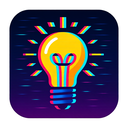
The icon in question is a visually striking fusion of three distinct yet profoundly interconnected themes: Gaming, Light Bulb, and Digital Glitch. At first glance, it captures the eye with its vibrant contrasts and dynamic energy, but upon closer inspection, it reveals a layered narrative that speaks to innovation, creativity, and the ever-evolving nature of digital experiences. This icon is not merely decorative—it is conceptual art distilled into a compact visual form.
At its core lies a stylized light bulb, the universal symbol of inspiration and ideas. However, this light bulb diverges from conventional representations. Instead of being static and glowing with steady illumination, it pulses with energy akin to an active video game character’s power-up effect. The filament within the bulb is not made of traditional wire but instead rendered as a glowing circuit board—thin metallic lines tracing intricate pathways that resemble a digital microprocessor. These filaments radiate bright neon hues: electric blue at the center, bleeding into vibrant magenta and cyan at the edges, creating an aura of high-tech brilliance.
The bulb’s glass casing is not clear or solid but fragmented with subtle digital glitch effects. Vertical and horizontal lines of corrupted data—pixelated fragments, shimmering static distortions, and chromatic aberrations—crisscross the surface like cracks in reality. These glitches aren’t chaotic; they are deliberately arranged to suggest an intentional disruption in the digital realm. The result is a light bulb that appears both luminous and unstable, embodying the paradox of brilliance born from imperfection—a perfect metaphor for innovation emerging from technological chaos.
Surrounding the bulb, in a circular halo, are stylized game controller elements: miniature analog sticks with pulsating joysticks, buttons rendered as glowing pixels (A/B/X/Y), and directional pads that flicker in sync with the bulb’s light. These game components are not solid but appear to be made of shifting digital code—streams of binary sequences (0s and 1s) flowing like water around the core, occasionally freezing into brief frames resembling classic video game sprites. The effect gives the impression that the entire icon is a live gameplay screen, where ideas are being generated in real time.
The background is not flat but dynamic—resembling a corrupted digital interface. Faint gridlines form an abstract maze of data packets, with occasional pixel bursts that resemble old-school arcade explosions. A subtle motion blur suggests the icon is in transition: either loading, transforming, or responding to user input. This animated quality enhances the sense of interactivity and immersion—a hallmark of modern Gaming culture where every interface element feels alive.
The color palette further reinforces the icon’s thematic depth. Dominant tones include electric blue (#00F3FF), hot magenta (#FF00E6), and cyber yellow (#FFFF33), colors frequently associated with digital aesthetics, futuristic interfaces, and retro gaming visuals. These hues are not applied uniformly but layered in gradients that mimic screen glare and light reflection—reinforcing the illusion of a glowing device on a dark monitor. The contrast between the vibrant core and the darker, glitch-dotted edges creates visual tension: innovation versus instability, inspiration versus system failure.
Importantly, every element serves a symbolic function. The light bulb represents original thought—central to both creative development and game design. Game developers often describe moments of breakthrough as "a light bulb moment," where solutions emerge from complex problems. Here, that moment is not silent or serene; it’s explosive, noisy with digital interference—a reflection of how modern creativity thrives in fast-paced, high-stakes environments like competitive gaming or indie game development.
The digital glitch element is not a flaw but a feature. In today's digital culture—especially in the world of Gaming—glitches are not just bugs; they are aesthetic phenomena, sources of humor, nostalgia, and even artistic expression. Glitch art has become a genre in its own right, celebrated for revealing the hidden beauty beneath code errors. By embedding glitches into the light bulb—a symbol of clarity and insight—the icon suggests that true innovation often arises from disorder. It challenges the viewer to see disruption not as failure but as possibility.
Furthermore, this icon functions perfectly within digital environments: app icons, gaming interfaces, UI elements for creative software (like game engines or design tools), and even promotional material for tech events or indie game showcases. Its complexity is balanced by readability at small sizes—thanks to bold contrasts and minimalistic detailing. Even when scaled down to 32x32 pixels, the core symbolism remains intact: a light bulb pulsing with digital energy, flickering with the unpredictability of code.
In essence, this icon transcends its components. It is not merely "a light bulb with a glitch" or "a gaming symbol with an idea." It is a visual manifesto—uniting the spark of inspiration (light bulb), the engine of digital experience (gaming), and the raw, chaotic beauty of system imperfection (digital glitch). It speaks to creators who build worlds from code, players who find joy in broken systems, and innovators who thrive where logic bends. This icon doesn’t just represent an idea—it embodies the spirit of digital creativity itself.
Create your own icon with our GoGPT AI prompt:
GoGPT