

Geography Airplane Tribal Free icon download
Download all to grab every PNG variant.
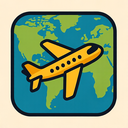
At the heart of this meticulously crafted icon lies a powerful fusion of three distinct yet harmoniously interwoven themes: Geography, Airplane, and Tribal. The result is a richly layered visual representation that speaks to human journeying across land and sky, the deep-rooted connection between cultures and their native territories, and the enduring spirit of exploration. This icon functions not just as a symbol but as a narrative artifact—telling stories of migration, discovery, ancestral wisdom, and global interconnection.
The foundational element of the icon is its representation of Geography. Dominating the central visual space is a stylized world map rendered in earthy tones—ochre, terracotta, deep forest green, and sandy beige—that evoke natural landscapes and ancient cartography. The continents are not depicted with modern precision but rather with flowing curves reminiscent of prehistoric cave paintings or tribal totems. Lines marking rivers and mountain ranges ripple like veins across the landmasses, suggesting lifeblood flowing through the planet. Each geographical feature is rendered with symbolic detail: mountains rise like ceremonial altars, valleys form spirals akin to sacred patterns found in indigenous art, and coastlines curve gracefully as if drawn by a hand guided by intuition rather than surveying tools. This cartographic representation transcends mere navigation; it embodies a spiritual geography—the idea that the land is alive, sacred, and imbued with memory.
Overlaid upon this geographic foundation is an airplane—yet not one of modern aviation’s sleek efficiency. Instead, the aircraft is rendered in a tribal-inspired aesthetic: its fuselage shaped like a stylized bird or serpent with wings that curve into intricate geometric patterns reminiscent of Polynesian or Andean textile designs. The plane’s body features concentric circles and zig-zag motifs found in African and Native American art, suggesting rhythm, movement, and ancestral lineage. The cockpit is represented by a small circular emblem adorned with a third eye motif—a symbol commonly associated with spiritual insight across many indigenous cultures. From the wings emerge stylized feathers or abstract flame shapes that seem to radiate energy outward into the surrounding space. The airplane does not dominate but instead harmonizes with the landscape, as if it were born from it—flying not in opposition to nature but as an extension of its spirit.
The integration of Tribal elements is both subtle and profound. Around the perimeter of the icon, a band of tribal motifs encircles the entire composition—reminiscent of ceremonial necklaces or body paint patterns passed down through generations. These include symbols such as sun rays representing vitality, handprints signifying collective memory, spirals denoting eternal cycles, and animal totems (like eagles for vision or wolves for loyalty) woven into the design. Each pattern is hand-drawn in a way that mimics traditional craftsmanship—slightly asymmetrical, imperfectly balanced—emphasizing authenticity over mechanical precision. The color palette draws from natural pigments: crushed minerals, plant dyes, and earth-based hues that connect the icon to its ancestral roots.
Crucially, the interaction between Geography and Airplane is not one of separation but of convergence. The plane’s flight path forms a meandering line that traces ancient trade routes—echoing the paths taken by early migratory tribes, explorers, and seafarers. This path intersects key points on the map: sacred mountains like Mount Olympus or Uluru, ancient river valleys such as the Nile or Amazon, and cultural heartlands from Papua New Guinea to the Andes. These locations are subtly highlighted with small tribal sigils—each a unique symbol of a specific people's identity and worldview. The icon thus becomes a living tapestry of human connection: showing how geography shapes culture, how flight expands understanding, and how tribal wisdom offers perspective on both.
Functionally, the icon serves multiple purposes. In digital design contexts—whether as part of a travel app, educational platform about world cultures, or environmental advocacy campaign—it conveys a message of global awareness tempered with respect for tradition. It encourages users to see exploration not as conquest but as reverence: a journey to understand rather than dominate. The airplane symbolizes progress and connectivity, while the tribal elements ground that progress in ethical responsibility and cultural humility.
Ultimately, this icon is more than a visual sign—it is an invitation. An invitation to travel with awareness, to explore geography with empathy, and to carry the wisdom of tribal heritage into our modern world. It reminds us that every flight across the skies carries within it echoes of ancient footsteps on earth; that maps are not just tools but stories; and that true discovery begins not when we reach a destination, but when we honor where we come from.
Create your own icon with our GoGPT AI prompt:
GoGPT