

Geography Bicycle Bold Free icon download
Download all to grab every PNG variant.
```html
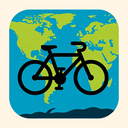
At first glance, this icon appears as a striking fusion of modern design and symbolic depth—an emblem that simultaneously captures the essence of human exploration, the spirit of sustainable transportation, and an undeniable sense of visual strength. The icon masterfully interweaves three core concepts: Geography, Bicycle, and Bold. Each element is not merely represented but elevated through intentional design choices that transform a simple graphic into a powerful visual statement. The central figure in the icon is a stylized, yet highly recognizable bicycle. Unlike traditional illustrations that depict bicycles with delicate lines or soft shading, this representation employs sharp, angular contours and thickened outlines—hallmarks of bold design. The frame of the bicycle is constructed from strong geometric shapes: a prominent diamond-shaped main frame rendered in solid black with slight gradient effects to suggest depth and dimensionality. The wheels are circular but not perfectly smooth; instead, they feature a series of thick, evenly spaced spokes that radiate outward with intense visual impact, symbolizing motion and forward momentum. The tires are wide and rugged—clearly designed for off-road terrain—suggesting durability, resilience, and the ability to traverse diverse landscapes. Yet this is no ordinary bicycle. Embedded within the wheel's structure is a subtle yet powerful representation of Geography. As viewers examine the tire closely, they notice that instead of a uniform black or gray band, one side features an intricate topographical map pattern—lines representing elevation contours in bold relief. These contour lines are not decorative; they are drawn with precision, mimicking real-world geographic data. The line weights vary subtly to suggest terrain changes: densely packed lines indicate steep inclines, while sparser ones show flatter ground. This integration of cartographic detail into the bicycle’s tire transforms the vehicle from a mere mode of transport into a symbol of geographical exploration. Further enhancing this connection to Geography, the handlebars extend upward and outward at an exaggerated angle, forming a dynamic arc that resembles mountain ranges on a world map. The seatpost is designed like a vertical scale bar, complete with tick marks that measure distance in kilometers and miles—another subtle nod to cartographic precision. The entire bicycle is positioned on a base shaped like the outline of Earth’s continents, with clear silhouettes of Africa, Europe, Asia, North America, and South America rendered in solid dark blue or gray. This continental base isn’t just a background—it is an integral part of the icon’s identity. It grounds the bicycle in real-world geography while simultaneously suggesting that this vehicle enables travel across both physical and conceptual landscapes. Nowhere is the element of Bold more evident than in the overall visual language of the icon. The entire composition uses thick, high-contrast lines—no thin strokes or delicate gradients. Every shape is defined with confidence and clarity; there are no faint edges or translucent layers. The color scheme reinforces this boldness: a dominant black base contrasts sharply against a vibrant primary blue, symbolizing both modernity and environmental awareness (a nod to eco-friendly cycling). A single accent of bright yellow highlights the front light of the bicycle, drawing immediate attention and suggesting purposeful movement. The proportions are deliberately exaggerated—wheels larger than life, handlebars stretching skyward, frame thick enough to suggest strength. This stylistic choice is not accidental. It communicates that this icon doesn’t just represent a bicycle or geography—it champions them with unwavering conviction. The boldness is both aesthetic and philosophical: it declares that sustainable travel through geographical exploration is not a passive activity but an active, powerful, and transformative experience. Moreover, the icon’s symmetry—while not perfect—feels intentional. The left side of the bicycle (from the viewer’s perspective) features more pronounced contour lines and geographic detail, while the right side remains simpler but equally bold. This asymmetry subtly suggests movement: a journey in progress. The bicycle isn’t parked—it is already in motion, weaving through continents and across maps. When used in digital interfaces—on maps, navigation apps, sustainability dashboards, or educational platforms—the icon immediately conveys multiple messages: "Explore the world," "Travel sustainably," and "Be unapologetically bold." It transcends mere representation. It becomes a call to action—a visual manifesto for environmentally conscious exploration. In summary, this icon is more than the sum of its parts. It combines the enduring symbol of the bicycle with deep reverence for geography, and delivers it with an unmistakable sense of bolder. Through bold lines, intentional geographic symbolism, and a dynamic form that suggests movement across landmasses, this icon stands as a testament to human curiosity, environmental responsibility, and artistic confidence. It is not just an image; it is an experience—a visual statement that says: the world is vast, the journey matters—and you can ride it with power and purpose. ```
Create your own icon with our GoGPT AI prompt:
GoGPT