

Geography Book Origami Free icon download
Download all to grab every PNG variant.
```html
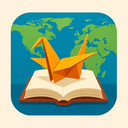
The icon presented is a meticulously crafted fusion of three profound symbols—Geography, Book, and Origami—each element seamlessly integrated into a single cohesive visual representation. This icon serves as a powerful metaphor for the interplay between human knowledge acquisition, spatial understanding of our world, and the creative process that transforms simple materials into complex forms. At first glance, it appears to be an elegant piece of art; upon closer inspection, its layered symbolism reveals a deep narrative about intellectual pursuit and innovative thinking.
The central form of the icon is a stylized origami figure—a geometrically precise paper crane—flying upward in dynamic motion. The crane’s wings are open wide, suggesting flight toward knowledge and exploration. Crafted with sharp, clean lines that mimic traditional Japanese origami techniques, the bird appears to be made of layered parchment or aged paper, subtly textured to suggest both durability and fragility. Its form is not static; rather, it embodies motion and transformation—a constant state of becoming—symbolizing the journey of discovery in geography and learning.
What makes this icon particularly significant is how the origami crane interacts with elements representing Geography. The wings of the crane are not mere decorative features; instead, they form a detailed topographical map when viewed from above. The outlines of mountain ranges, river systems, and coastlines are subtly etched into the paper's surface using thin white lines that contrast gently against the pale parchment color. These geographic elements are not arbitrary—they follow real-world patterns found in regions such as East Asia or Northern Europe, emphasizing both accuracy and artistic interpretation. As if drawn from an ancient atlas, these contours suggest a world being explored and understood through cartography.
Integrated into the body of the crane is a small, open book. The book lies flat along the bird’s torso, as though it has been unfolded from within or perhaps carried in flight. The cover of this miniature volume is embossed with symbols representing continents—each represented by a stylized silhouette in distinct colors: blue for water bodies, green for landmasses, and brown for mountainous regions. When the book opens slightly at the center, its pages reveal more intricate details—a detailed world map rendered in subtle ink lines that flow from one side to another like a continuous ribbon of discovery. This book is not merely an object; it is a living archive of human understanding of space and place.
Interestingly, the book itself appears to be crafted using origami principles. The cover folds into a three-dimensional structure, with creases forming precise angles that reflect the artistry inherent in paper-folding. The spine of the book is made from folded paper, creating a natural hinge that allows it to open and close gracefully—symbolizing how knowledge can be accessed and hidden depending on one's curiosity. This blending of materials underscores the idea that information (the Book), spatial understanding (Geography), and creative expression (Origami) are not separate disciplines but interconnected modes of human thought.
The background of the icon is composed of a faint, swirling pattern resembling longitude and latitude lines—subtly integrated into a soft gradient of blue and white. This celestial grid does not dominate the image but provides context, anchoring the crane and book within a larger framework that represents our planet’s spatial organization. It subtly reinforces the theme of Geography as both science and art—measured precision fused with aesthetic vision.
Color is used strategically to emphasize meaning. The origami crane is rendered in warm parchment tones, evoking ancient manuscripts and handwritten maps from centuries past. This earthy palette suggests timelessness, wisdom passed through generations. The book’s pages are slightly lighter—a soft cream—inviting the viewer to imagine flipping through them and uncovering new insights. Meanwhile, the map details on the wings are in muted black and dark blue, drawing attention without overwhelming.
Finally, light plays a crucial role in how this icon is perceived. A soft glow emanates from within the book’s open pages, illuminating the crane’s wings from below. This luminous effect suggests enlightenment—how reading about distant lands or studying geographic phenomena can ignite curiosity and inspire new ways of thinking. The light appears to flow outward, as if the icon itself is a beacon for learners, explorers, and creatives alike.
In essence, this icon transcends its visual form to become a philosophical statement: true understanding comes not from isolated disciplines but from their convergence. Geography informs the mind with spatial awareness; the Book preserves and transmits knowledge across time; Origami embodies the art of transformation—turning simple materials into something extraordinary through patience and precision. Together, they represent humanity’s enduring quest for meaning through exploration, learning, and creativity.
```Create your own icon with our GoGPT AI prompt:
GoGPT