

Geography Bus Pixel art Free icon download
Download all to grab every PNG variant.
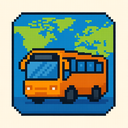
In the vibrant world of digital design, few concepts fuse cultural depth, functional utility, and artistic nostalgia as seamlessly as a pixel art icon that encapsulates the themes of geography, bus, and the retro-futuristic aesthetic of 8-bit gaming. This meticulously crafted icon is not merely a visual symbol; it’s a storytelling device that bridges continents, eras, and disciplines into one compact, nostalgic masterpiece.
The icon presents itself as a 16x16 or 32x32 pixel grid—a deliberate homage to the earliest days of video games—where each pixel is purposefully placed to convey both clarity and charm. Despite its minimal resolution, the image achieves remarkable detail through strategic color usage and smart composition. At its heart lies a stylized bus, rendered in classic pixel art form: a long, rectangular body with sharp angular edges mimicking the blocky design of 80s arcade vehicles. The bus is painted in vibrant, contrasting colors—electric blue for the main body, bright yellow for the roof and windows—and features a bold red stripe along its side. Two large, circular wheels are depicted with precise pixel precision: each wheel consists of a central hub surrounded by eight evenly spaced spokes arranged to suggest motion and rotation.
What elevates this icon beyond simple transportation imagery is the integration of geography. Embedded within the bus's front windshield is a small, intricate world map rendered in miniature. The map is not merely decorative; it serves as a central narrative device. It depicts Earth from a top-down perspective, with continents clearly outlined in subtle gradients of green and blue to represent landmasses and oceans. The pixelated coastline of South America stands out near the left edge, while Africa appears slightly offset toward the center—each continent drawn with careful attention to proportion despite the limited palette.
Crucially, a blinking red pixel (or a single-pixel pulse) is positioned over Western Europe—a visual cue that this bus is on a journey. This subtle animation element signals movement and directionality, transforming the static image into an evolving story of exploration. The route itself traces an abstract path: starting in London (represented by a tiny pixelated red dot), moving across the English Channel, then through France and Germany, before veering south into Italy—each point along the way indicated by a single colored pixel. These route markers are not literal representations but symbolic waypoints that evoke the spirit of geographical discovery.
The choice of pixel art as the medium is deliberate and meaningful. This artistic style harks back to an era when technical limitations demanded creativity and efficiency in design. In this context, every pixel becomes a storyteller. The constrained color palette—typically 4-16 colors—forces the designer to prioritize essential elements: the bus’s shape, its movement, and the geographical map's legibility. Colors are chosen not just for visual appeal but for functional clarity: green represents land; blue signifies water; yellow indicates urban centers or routes; red highlights dynamic elements like motion and waypoints. The absence of gradients or anti-aliasing is intentional—it reinforces authenticity to the pixel art tradition.
Beyond aesthetics, this icon carries symbolic depth. It speaks to the idea that travel is not just physical movement but an educational journey—especially through the lens of geography. The bus becomes a mobile classroom: as it travels across continents, it teaches users about different cultures, climates, topographies, and political boundaries. Each pixel on its route tells a story of human migration, trade routes, cultural exchange. In this way, the icon transforms into an educational tool suitable for interactive apps or digital textbooks designed for children or geography enthusiasts.
Furthermore, the fusion of bus and geography in pixel art format creates a unique hybrid identity. The bus is no longer just public transportation—it’s a vessel of curiosity, adventure, and learning. It reflects the democratization of travel: not every person can afford an airplane ticket, but a bus journey through imagined or real global routes remains accessible and symbolic of freedom and exploration.
From a technical standpoint, the icon is optimized for low-resolution displays—perfect for mobile interfaces where space is limited. Its compact size ensures quick loading times, while its bold contrasts make it legible even at tiny scales. The use of dithering (a technique to simulate color gradients using only a few colors) subtly enhances depth on the bus’s windows and map background, adding texture without violating the pixel art ethos.
In conclusion, this icon is more than just a digital image. It is a cultural artifact that merges nostalgia with modern educational values. Through its fusion of geography, bus, and pixel art, it encapsulates the joy of discovery, the simplicity of early digital design, and the enduring appeal of traveling—whether across a screen or across continents. In a world increasingly dominated by high-definition visuals, this tiny 16x16 masterpiece reminds us that sometimes, less is more—and that even in pixels, stories can be grand.
Create your own icon with our GoGPT AI prompt:
GoGPT