

Geography Car Pixel art Free icon download
Download all to grab every PNG variant.
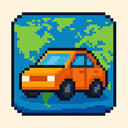
The icon in question is a meticulously crafted piece of digital art that masterfully blends three distinct yet harmonious concepts: Geography, Car culture, and the nostalgic charm of Pixel art. At first glance, it appears as a compact 32x32 pixel canvas—small enough to function seamlessly in user interfaces yet rich with symbolic meaning and visual storytelling. This tiny digital artwork encapsulates an entire narrative about travel, spatial awareness, and the intersection of technology with human movement across landscapes.
Geographically, the icon presents a stylized miniature representation of a winding road that snakes through varied terrain—mountains in the background rendered with simple triangular shapes in cool greens and blues; flat plains represented by light yellow and tan pixels; and scattered small trees made from pixel clusters resembling pine conifers. The road itself is a central diagonal path, drawn with alternating dark gray and beige pixels to create a sense of depth and movement. A key element that emphasizes the geographical theme is the inclusion of subtle cartographic cues: tiny pixelated contour lines near mountain peaks, dashed line segments indicating borders between regions (perhaps symbolizing country or state lines), and even a faint compass rose in the upper-left quadrant composed of just eight pixels—north marked by an upward-pointing white triangle. These features are not merely decorative but serve to ground the icon within a real-world spatial context, suggesting movement across physical environments rather than abstract motion.
The centerpiece of the icon is a retro-styled car, designed with unmistakable 8-bit charm. Crafted entirely from pixels, it measures approximately 12x8 pixels in its most compact form but exudes presence through strategic placement and detail. The vehicle is a classic two-door sedan from the late 1970s or early '80s—characterized by a rounded hood, boxy trunk, and prominent fenders. Its body is rendered in gradients of warm orange and beige pixels to suggest sunlight glinting off the paint, while tires are black with white outlines for contrast. The windshield is a single row of light blue pixels forming a horizontal rectangle; headlights appear as small yellow squares on either side. Most strikingly, the car appears to be in motion: its tail lights form a diagonal streak from lower-right to upper-left (a clever pixel trick used in classic games to imply speed), and there are faint blur-effect pixels trailing behind it—suggesting forward momentum across the landscape.
What elevates this icon beyond mere visual representation is how the Car functions not just as a vehicle, but as a symbol of geographical exploration. In many cultures, cars are deeply tied to mobility and discovery—the automobile has enabled humans to traverse distances once deemed impassable. Here, that narrative is embedded in design: the car isn't parked; it’s actively traveling through diverse biomes (mountains, plains), suggesting a journey across regions. This ties directly into Geography by emphasizing how transportation shapes our understanding of place and space. The icon becomes a metaphor for exploration—each pixel representing not just an image, but a step in the human endeavor to map, navigate, and understand the world.
The use of Pixel art is not incidental—it is foundational to the icon’s identity. Every shape is made from individual square pixels arranged with precision. No anti-aliasing or smoothing distorts its form; instead, bold edges and limited color palettes (typically 16–25 colors from a classic NES or Game Boy palette) give it an authentic retro gaming feel. This artistic constraint enhances the icon’s purpose: in the era of high-resolution graphics, this low-poly aesthetic harks back to simpler times when digital art was about creativity within limitation. The pixel-by-pixel construction invites viewers to appreciate the craftsmanship—how a few dozen carefully placed pixels can convey motion, terrain diversity, and narrative intent.
Functionally, this icon would serve excellently in map-based applications or travel apps where users track routes or explore geographical locations. When paired with a route marker system or GPS navigation tool, the pixel car becomes an avatar of the user’s journey—symbolizing both their physical location and their movement through space. It could also appear in educational tools teaching geography to children, where its playful yet informative style makes complex ideas accessible.
In conclusion, this icon is far more than a visual symbol—it is a multidimensional artifact that unites the analytical nature of Geography, the dynamic essence of the Car as a cultural and technological marvel, and the intentional artistry of Pixel art. It celebrates movement through space, celebrates human ingenuity in mapping our world, and honors a visual language rooted in digital history. In just 32x32 pixels, it tells a story of discovery—one pixel at a time.
Create your own icon with our GoGPT AI prompt:
GoGPT