

Geography Coin Organic Free icon download
Download all to grab every PNG variant.
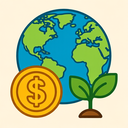
The icon presents a masterful synthesis of three distinct yet interconnected themes: Geography, Coin, and Organic. At first glance, it appears as a meticulously crafted emblem that transcends mere visual appeal—inviting the observer into a deeper narrative about the relationship between natural landscapes, human economic systems, and sustainable growth. Every curve, contour, and color choice is intentional; each element serves as a symbol of interdependence between earth's physical features, monetary value systems rooted in those lands, and life that evolves naturally within them.
At the core of the icon lies a stylized geographic map outline—abstracted into an elegant spiral shape. This spiral represents both the winding course of rivers and the concentric patterns found in topographical maps. The contours are subtly rendered using organic waveforms that mimic natural landforms: rolling hills, river deltas, mountain ridges, and fertile valleys. The lines are not rigid or mechanical but fluid and breathing—evoking a sense of life and motion inherent to the earth itself. These geographic features are not depicted in detail; instead, they are abstracted into minimalist silhouettes that suggest rather than define specific regions. This abstraction allows the icon to represent geography universally—not tied to any single country or region—but rather as an intrinsic quality of our planet's surface.
Embedded within this geographically inspired spiral is a central coin. However, this is no ordinary coin. It does not resemble any traditional currency—no inscriptions, no monarchs, and no standard denominations. Instead, it appears as a smooth disc with subtle textures resembling natural stone or polished wood grain. The surface of the coin features a symbolic design: at its center lies an intricate tree root system that spreads outward in fractal-like patterns—echoing both the complexity of ecosystems and the interconnectedness of economic networks. The roots symbolize foundational value, sustainability, and long-term growth—key principles often overlooked in conventional monetary systems.
The coin itself is rendered with a slight metallic sheen, but not the harsh glare of industrial metal. Rather, it has a warm, earthy luster—reminiscent of aged bronze or hammered copper—but subtly infused with natural textures. Tiny cracks and fissures are carefully etched into its surface, not as flaws but as intentional features suggesting the passage of time and the resilience born through natural wear. These imperfections reflect an organic philosophy: that value is not static, nor does it exist in perfection—it evolves over time through interaction with its environment.
Surrounding the coin and seamlessly integrated into the geographic spiral are delicate organic elements—veins of leaves, spiraling vines, and microscopic plant structures. These are not decorative flourishes but integral parts of the design. The vine-like tendrils extend from the base of the coin, winding through mountainous contours and flowing like rivers across plains. They symbolize how economic activity is fundamentally tied to natural resources: agriculture depends on fertile soil; trade relies on natural pathways like rivers and valleys; wealth emerges not from abstract numbers but from real land, labor, and life.
The color palette reinforces the thematic unity. Earthy browns, mossy greens, and soft terracottas dominate the icon’s background—colors drawn from soil, forests, and stone. Accents of golden ochre highlight areas where geography meets economy: where rivers meet fertile farmlands or where mountain passes historically served as trade routes. The coin's metallic sheen is not silver or gold in the traditional sense but a deep bronze with hints of rust and verdigris—indicating natural oxidation and the passage of time. This choice is deliberate: it suggests that true economic value should not be fleeting or inflated, but grounded in tangible, enduring elements.
One of the most striking aspects of this icon is its balance between order and chaos. The geographic outline provides structure—a framework for understanding space and location—but it’s interrupted by organic forms that grow unpredictably yet purposefully. This duality reflects a modern worldview: we seek to map the world (geography), assign value to its parts (coin), but must do so in ways that respect natural rhythms and limits (organic). The icon challenges the viewer to reconsider what constitutes wealth—asking whether it lies in numbers on a screen or in living ecosystems, sustainable agriculture, and resilient communities.
In essence, this icon is a visual manifesto. It merges Geography by celebrating the earth’s physical forms; Coin by redefining value as something tangible and rooted; and Organic by embracing natural imperfection, growth cycles, and interdependence. Together, these elements form a symbol of holistic sustainability—a vision where human economies thrive not in spite of nature but because they are inspired by it.
Whether used on a website promoting eco-conscious finance, an app focused on sustainable development, or an educational tool about planetary economics, this icon serves as a powerful reminder: true wealth begins with the land, is shaped by human ingenuity and exchange (the coin), and must flourish within the rhythms of nature (organic).
Create your own icon with our GoGPT AI prompt:
GoGPT