

Geography Credit card Iconic Free icon download
Download all to grab every PNG variant.
Imagine an icon that encapsulates the vast, intricate tapestry of human geography while simultaneously serving as a modern emblem of financial inclusion and technological advancement. This is not merely a design exercise—it is a profound symbolic synthesis where Geography, Credit card, and Iconic converge into one powerful visual metaphor. The result is an icon that transcends its functional purpose to become an enduring symbol in both digital interfaces and cultural consciousness.
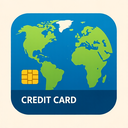
At its core, this icon embodies the concept of Geography through a meticulously crafted world map rendered in minimalist yet highly recognizable form. Rather than depicting a traditional political map with borders and country names, the design employs stylized continents that flow into one another with seamless continuity. The use of gentle gradients—shades of blue for oceans, green and brown for landmasses—creates depth without overwhelming detail. Each continent is subtly shaped to reflect its true geographical proportions while being abstracted enough to maintain aesthetic clarity at small sizes, ensuring legibility across devices from mobile screens to large-scale digital displays.
What elevates this icon beyond a simple cartographic symbol is the integration of a credit card element that appears not as an overlay but as an inherent feature of the geographical layout. Embedded within the design is a thin, metallic stripe running horizontally across the center of Africa—the continent chosen deliberately for its symbolic significance in global human history and origin. This stripe mimics the magnetic strip found on physical credit cards, complete with a subtle pattern resembling data tracks that suggest digital security and encrypted transactions.
The true innovation lies in how this credit card feature is not tacked onto the geography but emerges organically from it. The stripe begins as a thin line of metallic silver near the western coast of Africa and gradually evolves into an actual, scaled-down representation of a credit card—complete with a chip on the left side, embossed digits (perhaps subtly displaying "1234 5678 9012 3456"), and even a holographic security emblem in the top right corner. This transformation from geographical feature to financial instrument is seamless, suggesting that modern finance and global connectivity are not separate systems but interwoven aspects of contemporary civilization.
Why is this icon iconic? Because it captures a pivotal moment in human evolution—the merging of digital identity with planetary consciousness. In an age where a single click can facilitate a transaction across continents, where geographic borders are becoming less relevant in the realm of commerce and communication, this icon becomes more than decorative. It stands as a visual manifesto: that financial power is no longer confined to specific regions but distributed globally through technology. The credit card represents individual access and autonomy; the geography symbolizes shared planetary space. Together, they form a new paradigm of inclusivity—where anyone with digital access can participate in the global economy.
Functionally, this icon serves multiple purposes across applications: as a payment gateway selector for international users, as a branding symbol for fintech companies operating across borders, or as an educational tool illustrating the interconnectedness of modern economies. Its adaptability makes it iconic not just in design but in application—appearing on everything from mobile banking apps to international trade portals and even cultural exhibitions about global citizenship.
The icon’s visual language is both universal and deeply rooted in geography. The continents are recognizable even without labels, a testament to the human brain's ability to decode abstract forms into meaning—a hallmark of iconic design. The credit card elements are equally identifiable through global familiarity with financial technology, ensuring broad comprehension across cultures and languages.
Moreover, the color palette reinforces its symbolic weight. Earth tones dominate—greens for sustainability, blues for trust and stability—and are accented with metallic silver to evoke innovation and security. The absence of excessive detail or clutter ensures that the icon remains legible at tiny sizes (as small as 16x16 pixels) while still conveying profound meaning when enlarged.
In essence, this icon is not just a representation of geography and credit cards; it is a narrative in visual form. It speaks to migration patterns, economic networks, digital inclusion, and the shrinking of physical distances through technology. It tells the story of how we live now—not bound by borders but connected through data, finance, and shared human experience.
As an iconic symbol for the 21st century, this design captures a truth that resonates deeply: geography has evolved from a static map of land and sea into a dynamic network of relationships. And the credit card—the modern key to participation in that network—is no longer just a plastic rectangle, but a portal to global identity.
Create your own icon with our GoGPT AI prompt:
GoGPT