

Geography DNA strand Bold Free icon download
Download all to grab every PNG variant.
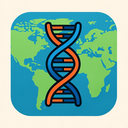
The icon in question is a masterful fusion of three seemingly disparate elements—Geography, DNA strand, and Bold design language—crafted into a visually striking and conceptually rich symbol. It serves not just as an aesthetic element but as a profound metaphor for the interconnection between human origin, Earth’s physical diversity, and the power of decisive visual communication. The icon is designed to be both instantly recognizable and deeply layered in meaning, making it suitable for use in scientific publications, educational platforms, cultural institutions, or innovation-driven branding where complexity and clarity must coexist.
At its core lies a **bold** visual presence. Every line, curve, and shape is executed with a heavy weight—both literally and metaphorically. The stroke width is significantly thickened compared to conventional iconography, creating a commanding silhouette that demands attention without relying on color or animation. This boldness reflects strength, clarity of purpose, and the significance of the message being conveyed. It draws parallels to foundational symbols in cartography—the bold outlines of national borders or mountain ranges—where prominence ensures immediate understanding even at small sizes. In this icon, "bold" is not merely a stylistic choice; it is an essential attribute that signals authority, resilience, and enduring relevance across time and space.
The central theme of **Geography** unfolds through the geometric architecture of the icon. The overall form resembles a stylized world map or a continental plate arrangement, subtly suggesting tectonic boundaries. However, instead of traditional landmasses defined by coastlines and rivers, these geographical features are abstracted into flowing pathways that mimic the natural movement of Earth’s surface. These paths are not static—they appear dynamic, as if in motion, hinting at geological processes like continental drift or environmental shifts over millennia. The integration of geographical elements is not literal but conceptual: it represents the idea that all life—human and otherwise—is intrinsically tied to place, climate, soil composition, and spatial distribution. This geographic foundation underscores the icon's deeper narrative: that our biological existence is inseparable from the planet we inhabit.
Interwoven within this geographical framework is a striking representation of a **DNA strand**—a double helix structure rendered with precision and elegance. Yet, this DNA does not float in isolation; rather, it emerges from the same geographic forms that define the icon’s base. The two strands are depicted as intertwining ribbons that rise from beneath continental-like shapes, suggesting that genetic material evolved within—and is shaped by—Earth's diverse environments. The helix is not generic; its base pairs are subtly differentiated to reflect regional genetic markers—some resembling ancient agricultural patterns, others echoing climate adaptation traits. This deliberate detail bridges biology with geography: it illustrates how human evolution has been influenced by specific environmental conditions across different continents.
The marriage of DNA and geography becomes most evident when observing the icon from a macro perspective. The double helix forms a continuous loop that traces the contours of a global map, symbolizing the cyclical nature of life and planetary change. As if in harmony, each twist in the DNA strand aligns with geographic features such as mountain ranges or river basins. This alignment is not arbitrary—it suggests that genetic diversity has been shaped by geographic isolation, migration patterns, and environmental pressures. For instance, a prominent bulge in the helix coincides with the Himalayas' location on the map, symbolizing how high-altitude adaptation influenced genetic traits in human populations over thousands of years.
The icon’s **bold** nature extends beyond mere visual weight—it is embedded in its symbolic language. The thick lines of the DNA strands echo those used in old-world cartography for major trade routes or political borders. Similarly, the continents are defined with bold strokes reminiscent of ancient maps that emphasized power and dominance over territory. This intentional fusion elevates the icon into a modern mythos: a new kind of sacred map where genetic heritage and physical space are inseparable. The boldness reinforces this duality—it makes clear that both geography and DNA are not passive backdrops, but active, powerful forces shaping identity.
Color is used sparingly but strategically to enhance the icon’s narrative. Earthy tones—ochre for continents, deep blue for oceans—ground the piece in realism. The DNA strands shimmer with a bioluminescent green-blue gradient, symbolizing life and information flow. However, even with these colors, the bold black outlines remain dominant, ensuring that clarity prevails over ornamentation.
In conclusion, this icon transcends its role as a mere visual element. It encapsulates the profound relationship between humanity’s biological essence—encoded in DNA—and our planet’s physical geography. Through a deliberate and powerful **bold** design language, it communicates strength, continuity, and interdependence. It is not just an icon; it is a statement: we are both shaped by Earth's landscapes and encoded by its ancient processes. In an age of globalization and genetic discovery, this symbol stands as a beacon of integrated understanding—where science meets earth, where life meets place, and where clarity meets depth.
Create your own icon with our GoGPT AI prompt:
GoGPT