

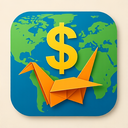
Geography Dollar sign Origami Free icon download
Download all to grab every PNG variant.
The icon presented is a masterful synthesis of three seemingly disparate concepts—geography, the dollar sign ($), and origami—crafted into a visually harmonious and symbolically rich design. At first glance, it appears as an elegant piece of paper art, but upon closer inspection, reveals layers of meaning that speak to global economic systems, spatial relationships across continents, and the timeless art of paper folding. The icon measures 64x64 pixels in its standard format but carries a symbolic weight far beyond its size.
At the heart of this design lies an intricately folded origami figure shaped like a stylized globe. Crafted from what appears to be thin, semi-transparent paper, the globe is formed through precise mountain and valley folds that suggest both geometric precision and organic flow. The base structure resembles a classic origami crane, but instead of wings extending outward in symmetry, the folds are adapted into continent-like shapes: North America curves slightly to the left with an arched ridge suggesting Alaska; South America tapers downward toward the bottom right; Europe and Africa form a gentle bulge at the center-right side; and Asia extends upward and outward from the top-left corner. This deliberate arrangement transforms a simple paper fold into a cartographic representation—fusing artistic expression with geographic knowledge.
The surface of this origami globe is subtly textured to evoke topographical features. Light gradients simulate mountain ranges, while soft blue washes suggest oceans and seas, all rendered with minimal but effective shading. Notably absent are political borders—no lines demarcating nations—but instead, the continents are unified in a seamless flow of paper folds that emphasize continuity over division. This design choice reflects a deeper philosophical statement: geography is not merely about maps and coordinates but about interconnectedness—a view echoed in modern global studies emphasizing planetary ecosystems and shared human experiences.
Embedded within this origami globe is the dollar sign ($), seamlessly integrated into the visual language of the piece. Instead of appearing as a separate, detached symbol, the dollar sign emerges from a fold on Africa’s eastern coast—a creative play that suggests economic power originating from or deeply tied to this region. The $ symbol is not rendered in bold lines but crafted in delicate paper-thin strokes, its horizontal bar subtly aligned with the equator while the vertical lines follow natural topographic contours. The crossbar of the dollar sign is shaped like a thin ribbon, echoing both currency and connectivity—just as trade routes have historically linked continents.
What makes this integration particularly compelling is that the dollar sign does not dominate but instead enhances the narrative. It appears as if it were folded into existence alongside the continent shapes, rather than imposed upon them. This subtle integration conveys a nuanced message: economic systems are not external to geography but are deeply woven into its fabric. The movement of goods, capital, and labor across borders—driven by market forces—mirrors the global circulation patterns studied in physical and human geography. Thus, the icon becomes an allegory for globalization: a world where paper (symbolizing information) folds into shapes that represent both landmasses (geography) and monetary value (dollar sign).
Color plays a crucial role in reinforcing the icon’s layered meaning. The globe itself is rendered in shades of pale blue and earthy beige, evoking natural materials like paper, clay, or sand—elements fundamental to both geography (soil composition, landforms) and origami (the medium). The dollar sign is highlighted in metallic gold—shimmering subtly under light—to draw attention without disrupting harmony. This golden accent does not suggest greed but rather the value of innovation, trade, and human ingenuity that have shaped economic systems throughout history. In this way, the color choice transforms what could be a symbol of materialism into one celebrating sustainable exchange and cross-cultural collaboration.
Functionally, this icon could serve in various digital contexts: as a visual metaphor for global economics education platforms, international development projects, or even eco-friendly fintech startups that emphasize sustainability across geographic regions. Its compact size ensures it remains legible at small scales while retaining symbolic depth when enlarged. The fusion of art and information invites viewers to pause and reflect—not just on what the icon represents but on how these three concepts are more interconnected than they first appear.
In conclusion, this icon transcends mere visual representation. It is a narrative in miniature: an origami globe shaped by human hands, bearing the imprint of economic systems that have evolved across continents, and reminding us that geography is not static but dynamic—shaped by movement, exchange, and creativity. Through the elegant merging of paper folding with cartographic understanding and financial symbolism, it speaks to a world where boundaries blur between art and science, land and economy, past traditions and future possibilities. It is not just an icon—it is a philosophy etched in paper.
Create your own icon with our GoGPT AI prompt:
GoGPT