

Geography Flower Digital glitch Free icon download
Download all to grab every PNG variant.
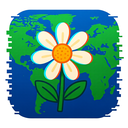
The icon is a meticulously crafted visual composition that masterfully intertwines three seemingly disparate elements—Geography, Flower, and Digital Glitch—into a single cohesive and symbolic entity. At its core lies a stylized world map subtly shaped like the outline of an unfolding flower petal, creating an immediate fusion between the physical landscape of Earth and the organic elegance of botanical life. This central element is not merely decorative; it functions as a conceptual bridge, suggesting that nature and geography are not separate from one another but deeply interconnected in both ecological and symbolic terms.
The world map is rendered in a gradient of earthy greens, deep blues, and warm browns—colors evocative of terrestrial ecosystems, oceans, and mountain ranges. However, instead of being static or traditionally cartographic, the map undergoes a deliberate transformation: its borders appear fractured and unstable. The continents are slightly distorted; coastlines flicker with irregularities that mimic natural erosion but are simultaneously suggestive of digital corruption. This duality is key—the geographical foundation remains recognizable yet perpetually on the verge of disruption, reflecting both environmental fragility and the influence of technology in shaping our perception of place.
Emerging from this fragmented map are several abstract petal shapes that grow outward like a blooming flower. Each petal is composed not just from geographical features—mountains become pointed tips, river systems curve into soft edges—but also from data streams and pixelated textures. The petals appear to be growing both upward and outward, symbolizing renewal, life, and the cyclical nature of ecosystems. Yet their forms are not pristine; they carry subtle distortions: sections of the petal flicker with color shifts (red bleeding into blue), lines stutter across their surface like corrupted video frames, and parts momentarily disappear before reappearing in a different position—an effect that embodies digital glitching.
These digital glitches are not random. They are strategically placed to represent key thematic intersections. In one petal, the outline of a rainforest in South America appears briefly as a high-definition image before dissolving into static, symbolizing deforestation and the loss of biodiversity in our digital age. On another petal representing Africa's savannas, data lines ripple through like heat waves on asphalt, suggesting climate change and environmental stress. The glitches do not degrade the icon’s message but rather emphasize it—showing how technology both documents nature (through satellite imaging, GIS mapping) and contributes to its degradation (via industrialization, pollution). The glitch is not a flaw; it is a narrative device.
At the center of this floral-globe hybrid sits an intricate digital flower—a bloom composed entirely of binary code, pixel fragments, and networked nodes. This central flower pulsates faintly in animation (if used in motion), with its petals opening and closing like breathing organs. The "stamen" is formed from interconnected data points representing cities, research stations, or protected wildlife reserves—each connected by thin lines resembling neural pathways or fiber-optic cables. This inner flower represents the convergence of digital consciousness and ecological awareness: a reminder that in today’s world, geographical knowledge is increasingly mediated through digital tools.
The color palette reinforces this duality. Natural hues dominate—the deep greens of forests, the cerulean of oceans—but they are frequently interrupted by artificial neon tones: magenta glitches, electric yellow stutters, and cyan fractures. These digital accents do not overpower but rather punctuate the natural elements like visual scars or electronic pollen grains spreading through the environment. The overall impression is one of a world in transition—where geography is no longer purely physical but also virtual, where flowers bloom not only in soil but on screens, and where digital glitches are more than technical errors; they are signs of transformation.
Functionally, this icon could serve multiple purposes. In environmental technology interfaces, it might symbolize data-driven conservation efforts. In educational apps about geography and ecology, it could represent the intersection of natural science and digital media. In artistic or activist contexts, the glitched flower becomes a metaphor for resilience—showing that even in moments of digital disruption or environmental crisis (symbolized by the glitch), life finds a way to bloom.
In conclusion, this icon transcends mere aesthetics. It is an intricate narrative told through form and color, where Geography provides the foundational map of our world, Flower offers a symbol of life and regeneration, and Digital Glitch represents both technological interference and transformative disruption. Together, they create a powerful visual language—one that speaks to the complex relationship between nature and technology in the 21st century. The icon reminds us that Earth's landscapes are not static relics but dynamic systems shaped by human innovation—and that even in moments of digital error, there is beauty, growth, and hope.
Create your own icon with our GoGPT AI prompt:
GoGPT