

Geography Globe 3D isometric Free icon download
Download all to grab every PNG variant.
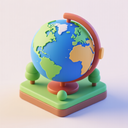
The icon under description is a meticulously crafted visual representation that elegantly synthesizes the concepts of geography, globe, and 3D isometric design into a single, powerful symbol. Designed for digital interfaces, educational platforms, geographic information systems (GIS), and academic publications, this icon transcends mere decoration—it serves as an instantly recognizable emblem of our planet’s spatial complexity and the scientific discipline dedicated to understanding it. At its core lies a **globe**, not as a static two-dimensional representation but as a dynamic, three-dimensional spherical model of Earth. This globe is rendered in precise 3D isometric projection—a visual technique that creates the illusion of depth on a flat surface by using parallel lines and consistent angles (typically 30 degrees) to depict height, width, and depth simultaneously. The result is an icon that appears to float in space while maintaining exact proportions and spatial clarity, making it ideal for use across various screen sizes and resolutions. The **3D isometric** nature of the design enhances its realism without sacrificing usability. Every contour of the globe follows a geometric precision that reflects the spherical nature of Earth while appearing to rotate subtly within its frame. The lighting model is carefully calibrated to create soft shadows and highlights, emphasizing depth and dimensionality. The curvature of continents, oceans, and mountain ranges is rendered with subtle gradients—blue for water bodies, green and brown for landmasses—that mimic natural color transitions on a real globe. This careful attention to tonal variation not only increases visual fidelity but also reinforces the icon’s purpose as an accurate geographical symbol. The **geography** aspect of this icon is profoundly embedded in its very structure. The continents are rendered with anatomical accuracy, based on up-to-date cartographic data from authoritative sources such as NASA and the United Nations. The African continent extends prominently in the center, while the Americas stretch toward the left and right edges—distorted slightly but proportionally to maintain recognizability within isometric constraints. Major geographical features such as river deltas, mountain ranges (like the Himalayas or Andes), and large oceanic basins are subtly implied through tonal gradients rather than explicit lines, preserving clean visual design while suggesting depth of information. What makes this icon particularly significant in the context of geography is its symbolic function beyond mere illustration. It serves as a metaphor for spatial awareness, planetary interconnection, and the interdisciplinary nature of geographical study. Geography encompasses physical features (like terrain and climate), human systems (urbanization, migration), environmental patterns, geopolitical boundaries, and even cultural landscapes—this icon encapsulates all these dimensions in a single visual form. The 3D isometric projection further enhances this symbolic depth. Unlike traditional flat maps that distort scale and shape depending on projection method (e.g., Mercator’s exaggeration of polar regions), the isometric globe offers a balanced, holistic view of Earth. It avoids the cartographic bias inherent in many two-dimensional representations, making it a more equitable visual metaphor for global understanding—an essential principle in modern geography education and international discourse. Design-wise, the icon incorporates subtle technical features to reinforce its geographic authenticity. The equator is clearly marked with a thin golden line that curves around the sphere at its midpoint, while the prime meridian and 180-degree longitude are faintly indicated through delicate grid lines rendered in a lighter shade. These elements don’t overwhelm the composition but subtly communicate measurement systems used by geographers worldwide. The icon’s edges are clean, with no hard borders or excessive outlines—ensuring it blends seamlessly into modern UIs. The background is typically transparent or neutral (light gray), allowing it to adapt to dark or light mode interfaces without visual clash. This flexibility makes the icon suitable for use in applications ranging from mobile apps and dashboards to scientific visualization tools. In educational contexts, this 3D isometric globe icon functions as a gateway to deeper learning. When clicked or hovered over, it can trigger interactive features such as zooming into specific regions, displaying climate zones, highlighting tectonic plates, or providing real-time data on population distribution—each reinforcing its connection to geography. Moreover, the visual language of 3D isometric design aligns with current trends in digital aesthetics. The style evokes a sense of modernity and technological sophistication while remaining intuitive. It appeals to younger generations accustomed to video games and virtual environments, making geographical concepts more accessible and engaging. In summary, this icon is far more than a simple image—it is a sophisticated fusion of art, science, and technology. By combining the universal symbol of the **globe**, the fundamental academic discipline of **geography**, and the advanced visual technique of **3D isometric** rendering, it creates a powerful representation that communicates planetary unity, spatial understanding, and scientific inquiry in a single glance. It stands as a testament to how design can enhance comprehension, inspire curiosity, and bridge disciplines in our increasingly interconnected world.
Create your own icon with our GoGPT AI prompt:
GoGPT