

Geography Globe Classic Free icon download
Download all to grab every PNG variant.
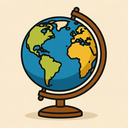
The icon we are describing is a masterful fusion of three essential elements—Geography, Globe, and Classic—each contributing to a design that transcends mere visual representation to become a symbol of human curiosity, historical exploration, and enduring intellectual pursuit. At its core lies the universal emblem of the Earth: the globe. This spherical depiction is not merely an approximation of our planet but an intricate artistic manifestation of humanity’s deep-seated desire to understand the world beyond our immediate surroundings.
The geography aspect of this icon is paramount, serving as both its purpose and foundation. Unlike abstract or stylized representations, this globe carries a profound cartographic authenticity. Its surface is meticulously detailed with accurately proportioned continents, clearly defined coastlines, and precise placement of major geographical features such as mountain ranges, rivers, and deserts. The inclusion of subtle topographical shading suggests elevation changes without overwhelming the visual clarity. Political boundaries are rendered with careful distinction—nations are delineated by clean lines that respect sovereignty while avoiding excessive complexity. This level of geographic fidelity transforms the icon from a decorative element into an educational tool, instantly communicating its thematic focus: the study and representation of Earth’s physical and cultural landscapes.
Yet what sets this icon apart is not just its geographical accuracy but also the way it embodies a timeless aesthetic—its classic design. This is not a modern, minimalist silhouette or a vectorized abstraction; instead, it draws inspiration from 19th-century cartographic traditions, where globe-making was both an art form and a scientific endeavor. The sphere itself possesses the gentle curvature of hand-crafted orbs, with subtle imperfections that suggest craftsmanship rather than digital precision. The meridians and parallels are rendered in delicate silver lines that curve elegantly around the globe’s surface, creating a grid reminiscent of antique celestial charts and nautical navigation tools. These lines do not merely serve functional purposes—they contribute to the icon’s visual harmony, forming a rhythmic pattern that guides the eye across its surface.
Coloration further enhances both its classic character and geographic clarity. A soft, muted palette dominates: deep navy blue for oceans, earthy green and beige for landmasses, with subtle variations in tone to represent different terrains. The continents are not rendered in flat colors but exhibit graduated shading that gives them a three-dimensional quality, as if illuminated by a gentle overhead light. This thoughtful use of color depth evokes the hand-painted maps of early explorers and scholars, where every hue carried meaning and intention. The absence of garish neon tones or excessive gradients reinforces its classic nature—a design unburdened by contemporary trends, instead rooted in enduring principles of balance, symmetry, and reverence for knowledge.
At the base of the globe rests a sturdy yet elegant pedestal that echoes 18th-century scientific instruments. Crafted with attention to detail—whether it be the subtle fluting on its shaft or the ornate brass detailing around its base—it suggests both stability and historical continuity. This feature reinforces the idea that geography, as a discipline, is built upon centuries of discovery and refinement. The pedestal also serves a symbolic role: it grounds the globe not just physically but intellectually, reminding viewers that understanding our world requires patience, research, and reverence for past contributions.
What makes this icon particularly powerful is its ability to communicate multiple layers of meaning simultaneously. To the casual observer, it may simply appear as a beautiful representation of Earth. To an educator or student of geography, it becomes a beacon of scientific inquiry and spatial literacy. To an art historian or designer, it embodies the elegance of pre-digital craftsmanship and the enduring appeal of traditional iconography. The fusion of geography with globe imagery creates a visual metaphor for exploration—both physical and intellectual—while the classic design ensures that this symbol remains relevant across generations.
In essence, this icon is more than a graphic element; it is a cultural artifact. It represents humanity’s quest to map not only the Earth’s surface but also our understanding of it. Through its meticulous attention to geographic detail, its reverence for historical design principles, and its embodiment of timeless elegance, this classic globe icon stands as a testament to the enduring importance of geography in shaping how we perceive and navigate our world.
Create your own icon with our GoGPT AI prompt:
GoGPT