

Geography Globe Digital glitch Free icon download
Download all to grab every PNG variant.
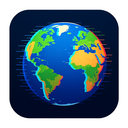
The icon is a dynamic visual representation that masterfully fuses the timeless essence of geography, the universally recognized symbol of global unity—the globe—with the bold, unpredictable energy of modern digital technology through a striking digital glitch effect. This intricate design transcends traditional iconography by transforming a static image into a living, breathing manifestation of our interconnected digital world and geographical awareness.
The central element is an intricately detailed 3D-rendered globe, rendered with high-resolution textures that mimic actual Earth's surface. From the vast expanse of oceans in deep cerulean to the lush greenery of continents and the intricate patterns of mountain ranges, every geographical feature is meticulously recreated. The globe is not flat or cartoonish—it has a spherical depth, with subtle shadows and lighting that simulate sunlight casting across hemispheres, giving it a realistic sense of dimensionality. This attention to geographical accuracy serves as both an educational tool and a visual anchor, instantly communicating the icon's core theme: our planet and its spatial relationships.
However, this realism is deliberately disrupted by a cascade of vibrant digital glitch effects. Jagged lines of static-like noise fracture the globe’s surface like cracks in reality. These distortions appear as fragmented pixels, color shifts (notably magenta and cyan bleeding into adjacent areas), and vertical or horizontal streaks resembling corrupted data streams. The glitch effect doesn’t merely overlay the globe—it actively interacts with it, causing continents to temporarily pixelate, oceans to ripple with digital artifacts, and borders between nations to flicker in and out of existence. This creates a sense of instability, suggesting that even our most fundamental understanding of geography is subject to digital reinterpretation and transformation.
Geographically speaking, the icon includes subtle yet meaningful cartographic details. The equator is marked with a faint golden ring, while lines of latitude and longitude are rendered in translucent gray—only partially visible due to the glitching interference. Major cities are denoted by tiny glowing dots that pulse at irregular intervals, mimicking real-time data updates from satellite tracking systems. Some landmasses appear slightly distorted or stretched during the glitch bursts, symbolizing how digital mapping technologies can sometimes distort geographic reality—either through scale errors, projection inaccuracies, or intentional data manipulation in visualization software.
The color palette is a deliberate fusion of natural and synthetic hues. Earth tones—forest green, ocean blue, sandy beige—are blended with electric neon colors: hot pink, lime green, and cyber blue—all bleeding through the globe’s surface like corrupted data streams. This chromatic clash emphasizes the tension between organic geography and digital representation. The glitch effect is not random; it follows a pattern that suggests algorithmic interference—perhaps simulating how satellite imagery, GPS signals, or geographic information systems (GIS) can be disrupted by network errors, cyberattacks, or atmospheric interference.
At the core of the icon’s design lies an implicit commentary on our evolving relationship with geography in the digital age. In centuries past, maps were hand-drawn and often subjective. Today, we rely on digital globes—Google Earth, NASA visualizations, real-time weather apps—where geography is not just observed but manipulated and streamed instantly across devices. The digital glitch effect acts as a metaphor for this duality: our ability to understand the world in unprecedented detail, while also being vulnerable to misinformation, data corruption, or technological failure.
The icon’s animation (if interactive) further deepens its meaning. The globe slowly rotates on its axis—symbolizing Earth’s natural motion—but every few seconds, a sudden glitch pulse interrupts the rotation. During these moments, the planet seems to “freeze,” then warp into abstract pixel patterns before snapping back into place. This rhythm mirrors how our digital perception of geography is often punctuated by interruptions: buffering maps, server errors, or outdated data.
Design-wise, the icon is optimized for scalability—equally effective on mobile screens and large displays. The glitch effect is subtle enough to remain aesthetically pleasing but bold enough to convey its narrative message. It would be ideal for applications related to geospatial analysis, digital cartography, climate tracking platforms, or educational tools focused on global awareness and technology literacy.
In conclusion, this icon is more than a visual symbol—it’s a conceptual bridge between physical geography and digital representation. The globe grounds it in reality; the intricate details of continents, oceans, and political boundaries reflect our deep-seated connection to place. Meanwhile, the aggressive yet artistic digital glitch effect challenges us to question how technology reshapes our understanding of the world. Together, these elements create a powerful narrative: that in our hyperconnected era, geography is not just about land and sea—it's also about data, code, and the ever-shifting digital landscapes we use to map them.
Create your own icon with our GoGPT AI prompt:
GoGPT