

Geography Globe Glassy Free icon download
Download all to grab every PNG variant.
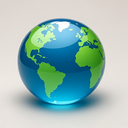
The icon in question is a masterful synthesis of symbolic representation and modern design aesthetics, seamlessly fusing the thematic elements of **Geography**, **Globe**, and **Glassy** into a single, captivating visual. At its core lies a meticulously crafted three-dimensional globe—a universal emblem representing our planet Earth and the scientific discipline of geography that studies its physical features, human societies, cultural patterns, climates, ecosystems, and spatial relationships. The globe is not merely stylized; it is rendered with an almost scientific precision that invites exploration at every glance. From a geographical perspective, this icon embodies the spirit of discovery and spatial understanding. Every curve of the earth’s surface reflects accurate cartographic proportions—continents are proportionally represented with careful attention to their relative positions and shapes, oceans shimmer in deep cerulean hues, and landmasses are subtly shaded to denote elevation variations. The inclusion of key geographical elements such as latitude and longitude lines, the equator, the prime meridian, and even faint outlines of major mountain ranges or river systems enhances its authenticity. These details are not merely decorative; they serve as visual cues that anchor the icon firmly in the realm of geography—the study that connects people to places, cultures to environments, and history to location. Yet what truly sets this icon apart is its **glassy** quality—a defining characteristic that elevates it from a standard cartographic representation into a work of modern digital art. The globe appears as though carved from polished crystal or high-grade tempered glass, refracting light with subtle brilliance. The surface reflects ambient lighting in dynamic ways: soft highlights dance across the oceanic regions, mimicking the shimmer of sunlight on water, while terrestrial areas catch light at varying angles to create a sense of depth and realism. This glassy finish gives the globe an ethereal transparency—though opaque enough to maintain structure—allowing viewers to perceive both its solid form and its inner luminosity. The glassy texture also creates an illusion of movement and fluidity, as if the planet itself is gently rotating in zero gravity. Subtle gradients simulate refractive distortion, especially near the edges and poles, lending a sense of realism akin to how light bends through actual glass or water. This effect enhances visual engagement: as viewers shift their gaze or the icon animates within a digital interface (such as on a mobile application or web dashboard), the reflections change in real time, reinforcing an immersive experience. Moreover, the glassy quality contributes metaphorically to the concept of geography. Just as clear glass reveals what lies behind it while still maintaining form and structure, geography provides clarity about our world—uncovering hidden patterns, revealing connections between distant lands, and illuminating how natural and human systems interact. The transparency suggests openness in knowledge: geography is not a closed system of facts but an ever-evolving field of understanding shaped by observation, technology (like satellite imaging), and interdisciplinary inquiry. In terms of design execution, the icon’s glassy finish is achieved through a combination of layered gradients, soft specular highlights, and anti-aliasing effects that mimic real-world optical properties. The color palette draws from nature: deep blues for oceans, lush greens for forests and plains, earthy browns for deserts and mountainous regions, and hints of white at the poles to suggest snowcaps. Yet these colors are not flat—they breathe with life due to the glass-like surface that modulates their intensity based on light direction. The icon’s frame or base—often minimalistic—further enhances the glassy effect. In many versions, it appears as a thin metallic stand or floating support structure, also rendered with reflective surfaces that mirror parts of the globe itself. This creates a sense of suspension, as though the entire world is hovering in space, held together by design and symbolism rather than gravity. From an iconographic standpoint, this glassy globe serves multiple purposes across digital platforms: it may represent educational tools for students learning about Earth sciences; navigation apps emphasizing location awareness; environmental organizations promoting global sustainability; or even international collaboration portals. Its aesthetic appeal ensures high recognition and user engagement—appearing both professional and aspirational. In essence, the icon transcends mere illustration. It stands as a symbolic gateway to the world of geography—a discipline rooted in understanding spatial relationships across time and space—while embodying the elegance of transparency, clarity, and technological sophistication through its glassy rendering. It invites users not just to see Earth as a physical entity, but to perceive it through the lens of curiosity, precision, and wonder—forever reflecting both our planet’s beauty and our enduring quest for knowledge.
Create your own icon with our GoGPT AI prompt:
GoGPT