

Geography Globe Pixel art Free icon download
Download all to grab every PNG variant.
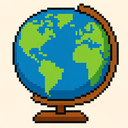
The pixel art geography globe icon stands as a unique and compelling fusion of historical cartographic tradition, modern digital aesthetics, and the enduring charm of retro game design. At first glance, this icon appears as a compact, stylized representation of Earth—its continents subtly outlined in vibrant hues against an oceanic backdrop—but upon closer inspection reveals itself to be a meticulously crafted piece of pixel art. Every square on the canvas is intentional; each colored pixel contributes to a broader narrative that speaks volumes about both geography and digital nostalgia.
At its core, the icon embodies geography, the scientific study of Earth’s surface, environments, and human interactions with them. The globe is not merely a decorative element but serves as an accessible visual metaphor for spatial understanding—a tool that helps users instantly recognize the global context in which information exists. The continents—Africa, Asia, Europe, North America, South America, Antarctica and Australia—are rendered in distinctive colors: green for lush landmasses, blue for water bodies and oceans (including the iconic Pacific and Atlantic), and hints of beige or tan to suggest deserts or arid zones. The outlines of these landmasses are carefully proportioned to resemble actual geographical features, capturing the essential shape of Earth without excessive detail. This balance between abstraction and accuracy makes it immediately recognizable as a world map while maintaining an artistic integrity that appeals to both educators and digital enthusiasts.
What truly sets this icon apart is its execution in pixel art, a digital art form rooted in the limitations and aesthetics of early computer graphics. Originating from 8-bit and 16-bit video games of the 1980s and '90s, pixel art relies on individual pixels arranged in grids to form images, textures, and animations. This technique demands precision, patience, and a deep understanding of visual composition at a granular level. The geography globe icon leverages these principles: every pixel is hand-placed by an artist or generated through algorithmic design with meticulous attention to shape consistency and color harmony.
The icon’s dimensions are typically small—often 32x32, 64x64, or 128x128 pixels—making it highly scalable for use across various digital platforms. Despite its compact size, the globe maintains remarkable legibility. The artist has strategically used contrast and color blocking to differentiate between land and sea: dark blue for deep oceans, lighter shades of blue for shallow waters, and a variety of greens and yellows to represent different types of terrain. Mountain ranges are suggested through subtle pixel clustering in cooler tones (grayish-blue), while the equator is marked by a thin line of white or yellow pixels—echoing vintage map design elements.
One remarkable aspect is how the icon captures a spherical form using flat, two-dimensional pixels. This illusion of roundness is achieved through careful shading techniques. The left side of the globe features darker tones to simulate shadow, while the right side brightens progressively toward the equator and pole regions—mirroring how light naturally falls on a sphere. The artist may also incorporate subtle gradients using dithering patterns (e.g., alternating pixel colors) to soften edges and create a sense of depth. These techniques elevate the icon from mere digital doodling to a sophisticated representation of form, space, and perspective.
The choice of pixel art style is not arbitrary; it imbues the icon with cultural resonance. For many users—especially those who grew up playing classic console games or retro arcade titles—the pixelated aesthetic evokes feelings of nostalgia, simplicity, and playful creativity. In an age dominated by high-resolution 4K graphics and photorealistic renders, this icon stands as a refreshing reminder of digital art’s humble origins. It suggests that complex ideas—like the interconnectedness of global cultures, ecosystems, or data points—can be communicated with elegance through minimalism.
In educational and informational contexts, the pixel art geography globe icon is particularly effective. It can serve as a visual anchor in apps related to world history, climate science, travel guides, language learning platforms (such as Duolingo), or global news aggregators. Its small size makes it ideal for use as a favicon or menu icon. Yet its symbolic power remains strong—its simplicity belies the complexity of geography itself. The globe represents not just Earth but also the idea of global citizenship, interdependence, and digital literacy.
Moreover, the pixel art style enhances accessibility and compatibility across devices. Unlike vector graphics that may require specific rendering engines or software support, pixel art icons are universally supported across platforms—from smartphones to legacy operating systems—making them ideal for cross-platform applications. The limited color palette (often 16–256 colors) also ensures faster loading times and lower bandwidth usage, a crucial consideration in performance-critical environments.
In conclusion, the pixel art geography globe icon is much more than a digital decoration. It is a harmonious convergence of geography, globe, and pixel art. It encapsulates the spirit of exploration, spatial awareness, and digital craftsmanship in a single, compact image. Whether used in educational software, gaming interfaces, or web design projects, this icon communicates the vastness of our world with minimal means—a testament to how powerful visual storytelling can be when rooted in both science and art.
Create your own icon with our GoGPT AI prompt:
GoGPT