

Geography Globe Simplified Free icon download
Download all to grab every PNG variant.
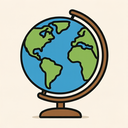
The icon in question is a masterfully crafted representation of geographical knowledge, distilled through the principles of minimalism and clarity. At its core lies a simplified globe—a circular form that encapsulates the essence of our planet with remarkable economy of design. The icon’s primary function is to symbolize geography, but it does so not through intricate details or excessive realism, but by embracing simplification as a deliberate artistic and communicative strategy.
From its initial glance, the icon conveys the idea of Earth with an immediate sense of recognition. The globe is depicted as a smooth sphere—free from complex textures, shaded gradients, or topographical features. Instead, it is rendered in two distinct yet harmonious colors: a soft blue to represent oceans and water bodies, and a gentle green for landmasses. This dual-tone palette allows viewers to instantly distinguish between continents and seas without overwhelming the visual field. The simplicity of color usage reflects an intentional effort to prioritize meaning over detail—an essential quality when communicating geographic concepts in digital interfaces, educational materials, or navigation tools.
The geographical accuracy of the icon is carefully balanced with abstraction. While it does not depict every country or river system as they appear on a traditional map, it maintains a recognizable silhouette of major landmasses. The continents are suggested through broad, flowing shapes that echo their general outlines—Africa appears as a large central mass, Eurasia forms an elongated eastern block, the Americas are shown in two distinct western bulges, and Australia is represented as a smaller southern island. These shapes are not precise to cartographic standards but serve their purpose: to evoke the global concept of Earth’s physical layout. This level of abstraction demonstrates how simplification can enhance rather than diminish understanding—by removing distracting details, the icon focuses attention on its central message: geography.
One of the most striking features of this icon is its intentional lack of ornamentation. There are no grid lines, latitude and longitude markings, political borders, or mountain ranges. No labels identify countries or regions. This absence is not a shortcoming but a design strength. By stripping away these elements, the icon transcends specific geographical narratives and becomes universally accessible—a symbol that belongs to all cultures and educational contexts. Whether used in an elementary classroom introducing children to world geography or in an international app for travel planning, the icon remains effective because its meaning is not tied to any one interpretation.
The globe is further enhanced by subtle design choices that reinforce its symbolic function. At the center of the sphere, a single vertical line rises from the bottom to pierce through what would be Earth’s axis—this minimalist representation of rotational symmetry subtly evokes planetary motion and orientation. It also suggests directional reference points without cluttering the image with compass roses or cardinal directions. The absence of such elements reinforces simplicity while still hinting at deeper geographical concepts like rotation, axial tilt, and the concept of poles.
From a technical standpoint, this icon is designed for versatility across platforms and screen sizes. Its clean lines and limited color scheme ensure it remains legible even when scaled down to tiny icons in mobile applications or system menus. The high contrast between blue and green ensures visibility against various backgrounds, while the circular format provides natural symmetry—making it visually balanced from any angle.
When viewed through the lens of geography, this icon embodies a fundamental truth: understanding our world begins with simplification. Geographers themselves often use models to represent complex systems—maps, globes, and diagrams all reduce reality to manageable forms. This icon is not an accurate replication of Earth but rather a conceptual tool—an emblem that stands for geographic knowledge as a whole. It suggests the interconnectedness of lands and waters, the diversity of ecosystems, and the shared human experience across borders.
Moreover, this icon’s simplicity speaks to broader cultural shifts in design philosophy. In an age saturated with information overload, there is growing value placed on clarity and intentionality. This icon reflects that ethos: it communicates more by saying less. It invites users not to dissect every detail but to grasp the bigger picture—the idea of Earth as a unified sphere where geography defines our relationships with land, climate, culture, and history.
Ultimately, the combination of Geography (the subject), Globe (the symbol), and Simplified (the approach) creates a powerful visual statement. It is not merely an icon; it is a philosophy in form—a reminder that true understanding often comes not from complexity, but from clarity. In its elegant minimalism, this icon achieves what all great symbols must: it tells a vast story with just one glance.
Create your own icon with our GoGPT AI prompt:
GoGPT