

Geography Heart Origami Free icon download
Download all to grab every PNG variant.
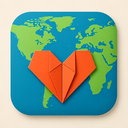
In the realm of visual symbolism, few icons manage to transcend their literal form to become vessels of profound meaning. This particular icon stands as a breathtaking synthesis of three seemingly disparate concepts—Geography, Heart, and Origami—woven together into a single, harmonious design that resonates on intellectual, emotional, and artistic levels. At first glance, the icon appears as an elegant piece of paper art—a meticulously folded origami heart—but upon closer examination reveals deeper layers of meaning rooted in the study of our planet and the emotional core that unites humanity.
The foundation of this icon is an intricately crafted origami shape, representing not just a traditional paper fold, but a metaphorical journey. Crafted from a single square piece of paper—symbolizing wholeness and potential—the heart emerges through precise folds: the base corners are folded inward to form the lower lobes, while diagonal creases define its upper curvature. Every fold is deliberate and exact, evoking both mathematical precision and artistic expression. The symmetry of the shape reflects balance—not only in physical form but also in the concept of equilibrium between nature and nurture, logic and emotion.
What transforms this simple origami heart into a profound symbol is its integration with geographical elements. Embedded within the folds—particularly along the upper edges—are subtle, hand-drawn contour lines reminiscent of topographical maps. These lines do not depict any specific location but instead suggest a universal landscape: mountains gently rising, valleys cradling rivers, and plateaus stretching across an imagined world. The use of minimalistic shading and gradient tones gives the illusion of terrain beneath the paper surface. This subtle integration is genius in its simplicity—geography isn’t imposed upon the heart; it is born from within it.
Moreover, one can discern faint constellations or celestial markers near the apex of the heart—a nod to cartographic traditions that once mapped both land and stars. The central point of the folded heart pulses with a soft inner glow, symbolizing not just love, but awareness: an awareness of where we are in space and time. The icon thus becomes a compass for emotional geography—a reminder that every feeling has a location, every memory a map.
The color palette is carefully chosen to reflect this duality of emotion and environment. A deep oceanic blue forms the base, representing both the vastness of Earth's oceans and the depth of human emotion. The heart’s folds transition into warm terracotta and earthy greens at the center, echoing fertile soils, forests, and landscapes teeming with life. A delicate blush pink emerges on the outer edges—the hue of a sunrise over a distant continent—suggesting new beginnings, hope, and connection across boundaries.
What makes this icon truly exceptional is its interactivity in perception. Viewers are invited to engage not just visually but emotionally and intellectually. The origami aspect challenges the viewer’s spatial reasoning; one cannot help but imagine how such a structure would unfold, or what hidden patterns lie beneath the surface folds. This mimics the way we explore geography—through layers of discovery, from satellite imagery to personal experience.
Emotionally, the heart is central. It is not a clichéd romantic symbol but rather a representation of compassion for our planet and all its inhabitants—a "heart" for Earth itself. The act of folding paper into a heart evokes care, patience, and intentionality—qualities essential to sustainable living and global empathy. Every fold in the origami can be seen as an act of mindfulness, a gesture that reminds us: love is not passive; it requires effort, shape, structure.
Furthermore, the icon subtly incorporates cultural motifs from around the world. In one of the folds—just visible if tilted toward light—is a tiny representation of a traditional Japanese kamon (family crest), echoing origami’s roots in Japanese culture. Meanwhile, other parts bear faintly etched symbols from indigenous mapping systems: Aboriginal dot art patterns, Inuit star charts, and Maori spiral designs. This cultural mosaic underscores the universal nature of geography and emotional connection—no one people owns the land or the heart.
When viewed from above, the icon resembles a stylized world map shaped like a heart. The continents are not rendered in literal form but implied through color gradients and tonal variations—Africa as a warm ochre blot, South America forming an upward curve like a rising breath, Europe and Asia layered in soft grays. The Arctic Circle is subtly indicated by frost-like patterns near the apex—a gentle reminder of climate fragility.
In conclusion, this icon is not merely decorative; it is a philosophical statement. It proclaims that geography is not just about latitude and longitude—it’s about belonging, connection, and responsibility. That the heart—our seat of love and empathy—is also deeply rooted in place. And that origami—the art of transformation through patience and precision—mirrors humanity’s journey: folding complexity into beauty, chaos into order, separation into unity.
It is a symbol for our time: a reminder that to care for the Earth is to love it with all your heart; and that every act of understanding our planet begins with a single fold in the right direction.
Create your own icon with our GoGPT AI prompt:
GoGPT