

Geography House Simplified Free icon download
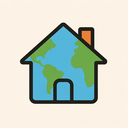
Download all to grab every PNG variant.
The icon in question is a masterful synthesis of three core concepts: Geography, House, and Simplified. At first glance, it presents a minimalist yet evocative image that transcends mere visual representation—it encapsulates the essence of spatial identity, domestic comfort, and design clarity. This icon is not just an abstract symbol; it functions as a universal language for understanding human connection to place and shelter in the modern era.
The foundation of this icon lies in Geography, representing not only physical locations on Earth but also the deeper meaning attached to where people live, grow, and belong. While geography often conjures images of intricate maps with shaded regions, latitude lines, and detailed topographical features, this icon takes a radically different approach—one grounded in abstraction and symbolic clarity. Instead of showing a complex world map or contour lines, it uses a single stylized house as the central element. This choice is deeply intentional: the house becomes the geographic anchor point.
By placing a house at the heart of its composition, the icon implicitly suggests that every individual’s geographical identity begins with their home. A home is not just a structure—it is a nexus of personal geography. It marks where someone resides, how they interact with their immediate environment, and how they perceive space on both micro (neighborhood) and macro (city or country) levels. The icon transforms the concept of "home" into a geographical reference point—much like a pin on a map that signifies not just coordinates but stories, memories, and cultural associations.
Furthermore, the simplicity of the house design allows it to transcend specific regional architectures. It does not represent an English cottage, Japanese machiya, or American ranch home—it is universal. This universality reinforces its role in geography: while physical landscapes vary across continents and climates, the concept of a dwelling remains a constant human feature on every inhabited landmass. Thus, the icon speaks to global diversity through uniform representation—a true testament to how geography connects us all through shared spatial experiences.
The House is not merely a visual motif in this icon—it is the symbolic core. It represents more than shelter; it stands for safety, identity, belonging, and continuity. In human culture across time and civilization, the house has been a fundamental institution. From ancient cave dwellings to contemporary high-rises, the house remains one of humanity’s most enduring creations.
In this icon's design, the house is rendered with clean lines and minimal components: a simple square or rectangle as the main body, a triangular roof (symbolizing protection), and a small rectangular door. There may be one or two windows—perhaps just two dots for eyes—to convey life without overcomplication. This level of simplicity doesn’t reduce its significance; rather, it amplifies it by stripping away all non-essential elements.
Every element is deliberate. The roof protects the inhabitants from weather, echoing the house’s primal function as a barrier between human life and nature’s forces. The door represents entry—both physical and emotional—into a personal realm where identity is formed and nurtured. Windows allow light in, symbolizing openness to the outside world while maintaining privacy within.
When viewed through the lens of geography, the house becomes an emblem of localized culture. Where a house is built reveals much about its environment: coastal homes may feature elevated foundations; desert homes may have thick walls for insulation; mountain homes often face south to capture sunlight. Though this icon doesn’t reflect such specific adaptations, its presence implies these deeper connections. It invites viewers to consider how geography shapes domestic architecture and, in turn, how architecture shapes our relationship with the world around us.
The final pillar of this icon is Simplified. This principle guides every aspect of its creation—form, color, line weight, and proportion. The design adheres to the core tenets of minimalism: clarity over complexity, function over ornamentation, and universality over specificity.
Every stroke in the icon serves a purpose. There are no decorative flourishes or extraneous details. This lack of clutter enhances legibility across various scales—from tiny app icons on smartphones to large signage at urban transit hubs. The icon remains instantly recognizable even when reduced to 16 pixels, demonstrating its effectiveness in digital environments.
Color choices reinforce the simplified nature of the design. Typically, a single neutral hue—such as soft gray, warm beige, or deep navy—is used. This monochromatic approach prevents visual noise and ensures that the icon blends seamlessly with diverse user interfaces. The absence of gradients or shadows keeps it timeless and accessible.
More importantly, simplification in this context is not about being basic—it’s about being intentional. By reducing the house to its most essential form, the icon becomes more powerful. It strips away cultural, historical, and architectural noise so that only the fundamental idea remains: home as a spatial entity within a larger world. This minimalism enables cross-cultural understanding—no matter your language or background, you recognize it instantly.
This icon is more than a visual element; it is an ideological statement. It bridges the vast field of Geography, the intimate concept of the House, and the modern design philosophy of Simplified. Through its clean lines and universal symbolism, it communicates that every person’s journey in life begins with a place—home—and that understanding our spatial identity is central to navigating an increasingly interconnected world.
In an age of digital mapping, remote work, and global mobility, this icon serves as a grounding symbol: no matter how far we travel or how complex our surroundings become, the house remains the anchor. And through its simplified design, it reminds us that clarity—both in form and meaning—is one of humanity’s greatest strengths.
Create your own icon with our GoGPT AI prompt:
GoGPT