

Geography Medical cross Retro Free icon download
Download all to grab every PNG variant.
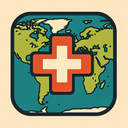
The icon in question presents a remarkably intricate and evocative fusion of three seemingly disparate concepts—geography, the medical cross, and retro design aesthetics—that converge into a single powerful visual narrative. This meticulously crafted emblem serves as both an artistic statement and a functional symbol for organizations operating at the intersection of healthcare accessibility and geographical awareness. At first glance, it appears as a nostalgic artifact from mid-20th-century graphic design; upon closer inspection, its layered symbolism reveals a deep conceptual depth that resonates with contemporary global health challenges.
The visual foundation of the icon is rooted firmly in retro design principles, reminiscent of 1950s and 1960s medical posters, travel brochures, and public service announcements. The color palette draws from the era's bold yet harmonious combinations—crimson reds resembling vintage blood samples, mustard yellows echoing old map ink, electric blue tones akin to early aviation charts, and crisp white backgrounds that suggest pristine paper or linen surfaces. A subtle grain texture overlays the entire icon, evoking the feel of aged photographic paper or a faded lithograph—further emphasizing its nostalgic quality.
At the center of this retro masterpiece lies a stylized medical cross, but one transformed through creative interpretation. The traditional four arms are elongated and subtly curved to mimic longitude and latitude lines on a globe, effectively integrating the symbol of medicine with cartographic elements. The cross's arms taper at their ends into delicate arrowheads that point toward cardinal directions—north, south, east, and west—establishing an immediate connection with geographical navigation. This innovative reinterpretation turns the medical cross into a functional compass for healthcare delivery.
The background of the icon is a detailed topographical map rendered in vintage style. Using muted tones of green for lowlands and brownish-orange for mountainous regions, the map features hand-drawn rivers flowing through valleys with irregular, organic shapes that evoke early 20th-century cartography. Notably absent are modern geopolitical boundaries—instead, the continents appear as if they were drawn by an anonymous explorer from a time before national borders dominated global discourse. The absence of political lines suggests a universal approach to health: one not constrained by borders but rather driven by human need across all regions.
In the upper left quadrant, nestled within what appears to be a mountainous region on the African continent, sits an old-fashioned red-and-white hospital insignia—an emblem that might have adorned field clinics during mid-century humanitarian missions. This detail reinforces the icon's focus on medical infrastructure in remote or underserved areas. Meanwhile, in the lower right corner of the map, near what looks like a tropical archipelago (possibly Southeast Asia), a tiny airplane—its design unmistakably resembling those from 1950s aviation graphics—traces a dotted flight path toward a central point on the island. This route symbolizes mobile medical units or airborne supply deliveries, crucial for reaching isolated communities.
Surrounding the entire composition is an ornamental border composed of interwoven ribbon motifs reminiscent of 1950s travel posters and medical award insignias. These ribbons form a continuous loop, suggesting continuity, cycles, and enduring commitment—key themes in both public health and geographic exploration. Embedded within the ribbons are small iconographic details: a compass rose near the top center (reinforcing navigation), a stethoscope curving like a river on one side, and an atom symbol subtly integrated into another section to hint at scientific advancement.
The typography associated with this icon—should it be used in conjunction with text—adheres strictly to retro standards: bold, sans-serif fonts with slight serifs at the terminals, resembling those popularized by early medical journals and global travel agencies. Any accompanying text would likely feature a subtle drop shadow and color gradient typical of mid-century design to maintain visual coherence.
Functionally, this icon serves as a powerful emblem for organizations focused on geographically targeted health initiatives—such as disease eradication programs in remote regions, mobile clinics in mountainous or island communities, or international medical aid efforts. Its retro aesthetic does not undermine its modern relevance; rather, it enhances it by suggesting continuity and legacy—implying that today’s global health challenges are part of a long-standing human endeavor to care for one another across vast distances.
In essence, this icon masterfully blends the humanitarian spirit of the medical cross with the spatial awareness of geography and the timeless charm of retro design. It is not merely a symbol, but a story—of exploration, empathy, and resilience—all wrapped in a visual language that feels both familiar and profoundly meaningful. As a piece of graphic art, it stands as an homage to past eras while pointing decisively toward a more connected, compassionate future.
Create your own icon with our GoGPT AI prompt:
GoGPT