

Geography Moon 3D isometric Free icon download
Download all to grab every PNG variant.
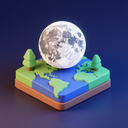
The icon is a meticulously crafted, visually striking representation that seamlessly merges three distinct yet harmoniously connected themes: Geography, Moon, and 3D isometric design. This digital artwork transcends conventional symbol design by combining scientific accuracy with artistic elegance. The result is a dynamic, layered visual metaphor for Earth’s cosmic relationship with its natural satellite—the Moon—while simultaneously highlighting the spatial and cartographic dimensions of our planet's surface.
At the core of the icon lies a stylized, 3D isometric rendering of Earth. Unlike flat or two-dimensional illustrations, this version presents Earth in a perspective that simulates depth and volume by using parallel projection at precise angles—typically 30 degrees from vertical—giving it an immersive, tangible quality. The planet appears suspended in the vastness of space, not as a distant dot but as a fully realized globe with visible geographical features. The surface is rendered with high-resolution cartographic detail: continents are clearly delineated with smooth yet textured edges, oceans shimmer with varying shades of blue representing depth and current patterns, and coastlines are accurately depicted based on real-world topography.
What distinguishes this icon from generic Earth illustrations is the integration of subtle geographical elements. Mountain ranges rise in sharp relief using gradient shading to suggest altitude. Major rivers such as the Nile, Amazon, and Yangtze are traceable with thin lines that mimic their actual paths. Even tectonic plate boundaries are hinted at through faint line overlays, subtly reinforcing the scientific depth of the geographical theme without overwhelming visual clarity. A small but noticeable detail is a network of grid lines—parallels and meridians—that subtly emphasize Earth’s spherical geometry and its cartographic mapping heritage.
Hovering in close proximity to the Earth, yet not touching it, is a perfectly proportioned 3D isometric rendering of the Moon. The lunar surface is modeled with authentic topographical features: craters of varying sizes are etched into its grayish-white terrain, with some illuminated by a soft light source to simulate sunlight from above. The crater Tycho, for instance, stands out due to its bright ray system fanning outward—a nod to real astronomical observation. The Moon's surface texture is rendered with micro-detail: fine dust-like patterns and subtle shadowing give it the gritty realism of an actual satellite orbiting Earth.
What makes this icon particularly compelling is how the 3D isometric perspective enhances both the geography and lunar elements. The camera angle, set at a 45-degree tilt with consistent vanishing points on both left and right sides, creates a sense of space that allows viewers to perceive depth across all components. Earth and Moon are not merely placed side by side; they exist in a shared three-dimensional environment where spatial relationships become as important as their visual representation. The icon employs linear perspective techniques: objects closer to the viewer appear larger with bolder lines, while those further away recede into the background using consistent scale reduction. Shadows cast by Earth onto the Moon (and vice versa) are calculated based on a defined light source, reinforcing the realism of their physical interaction.
Additionally, faint orbital arcs—depicted as semi-transparent isometric curves—are drawn between Earth and Moon, symbolizing gravitational pull and cyclical motion. These arcs subtly suggest the lunar orbit without distracting from the primary visuals. The entire composition floats within an abstract cosmic backdrop composed of star-like dots in a deep space black background, arranged in a way that feels neither random nor cluttered—each dot positioned with intention to enhance depth perception.
The color palette is carefully chosen to balance scientific authenticity and visual appeal. Earth features blues (oceans), greens and browns (landmasses), and whites (polar ice caps). The Moon, by contrast, uses a desaturated gray tone with slight variations in lightness across its surface to reflect differing albedo levels. Highlights on both bodies use soft white or pale yellow tones to simulate sunlight reflection, enhancing the 3D effect. No bold or garish colors are used—this ensures that the focus remains on form, space, and meaning rather than stylistic noise.
Functionally, this icon is ideal for digital platforms related to astronomy education, geographical information systems (GIS), space exploration projects, or environmental studies. Its 3D isometric style makes it easily scalable without loss of quality—perfect for responsive web design or high-resolution displays. The layered depth and clarity also make it suitable for interactive applications: users can zoom in on Earth's continents or examine lunar craters via hover effects, turning the icon into an educational gateway.
In essence, this icon is more than a symbol—it is a narrative. Through Geography, it represents our planet’s physical and cultural landscapes; through the Moon, it evokes wonder, mystery, and our deep connection to celestial bodies; and through its masterful 3D isometric execution, it transforms abstract concepts into a tangible experience of space, scale, and scientific beauty. It stands as a testament to how visual design can communicate complex interdisciplinary ideas with elegance and precision.
Create your own icon with our GoGPT AI prompt:
GoGPT