

Geography Moon Origami Free icon download
Download all to grab every PNG variant.
```html
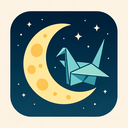
The icon presents a profound visual synthesis of three seemingly disparate elements—Geography, the Moon, and Origami—into a single, intricate symbol that encapsulates both scientific wonder and artistic elegance. At first glance, this icon appears as an elegant origami sculpture floating in space; however, upon closer inspection, it reveals layers of meaning rooted deeply in the interconnectedness of Earth’s spatial sciences (Geography), celestial phenomena (the Moon), and the ancient Japanese art of paper folding (Origami).
The central figure is a stylized three-dimensional origami moon, meticulously crafted to resemble a crescent-shaped satellite with subtle geometric folds. The surface of the moon is not smooth but intricately folded using precise pleats and valleys, evoking the traditional techniques of origami. These folds are not merely decorative; they form a visual language that represents topographical features such as lunar craters, maria basins (dark plains), and mountainous ridges. Each fold is carefully angled to suggest elevation and depth, creating the illusion of a celestial body rendered from paper yet possessing tangible texture and dimensionality.
Geographically, the moon’s surface is mapped with subtle cartographic details that mirror actual lunar topography. The iconic craters—such as Tycho, Copernicus, and Mare Tranquillitatis—are implied through strategic placement of folds and shadows rather than literal drawings. The artist has used the paper-folding technique to simulate terrain variations: convex folds represent elevated regions like mountains, while concave depressions suggest impact basins. This fusion of origami with cartographic representation transforms the icon into a microcosm of planetary geography—not just Earth’s geography but lunar geography as well, emphasizing that geographical study extends beyond our own world and into celestial bodies.
The moon is depicted in a gentle crescent phase, its illuminated edge facing outward, symbolizing both scientific observation and poetic resonance. The light source appears to come from the upper left of the composition—likely representing Earth’s position in space—casting soft shadows across the folded surface. These shadows enhance depth and give the illusion of three-dimensionality, reinforcing the idea that this is not a flat image but a spatial artifact. The moon hovers slightly above what appears to be a stylized, abstract globe of Earth—a miniature representation created using minimal yet meaningful lines and folds.
Earth, rendered in minimalist origami form, sits below the lunar crescent like a delicate paper orb resting on an invisible plane. It is composed of three main color regions: deep blue for oceans, green for continents, and white for polar ice caps. The continents are simplified but identifiable—North America, South America, Africa, Europe/Asia—and their boundaries are suggested not with rigid lines but with subtle creases that mimic the natural tectonic divisions of our planet. This paper-geography approach underscores how geography is not only about physical landforms but also about patterns and relationships between places—a concept beautifully embodied in origami’s emphasis on structure and symmetry.
Crucially, the connection between Earth and Moon is not merely spatial but symbolic. The two celestial bodies are linked by a thin, delicate paper ribbon—another origami element—that spirals upward from the edge of Earth to wrap around the lunar crescent. This ribbon represents both gravitational influence and human curiosity: it symbolizes how geography connects us to the cosmos through scientific inquiry, while also echoing how art (origami) can bridge abstract concepts with tangible expression. The ribbon’s folding pattern follows a Fibonacci sequence, subtly referencing natural growth patterns found in both celestial mechanics and biological systems—a nod to the underlying order that governs both geography and nature.
Color plays a vital role in this icon. The moon is rendered in cool silver-gray gradients, with faint hints of blue at its edges—suggesting the ethereal glow of reflected sunlight. Earth, by contrast, is warmer: a combination of soft turquoise for oceans and muted emerald for forests. The paper itself appears slightly translucent when backlit, suggesting fragility and impermanence—a metaphor for both our planet’s vulnerability and the ephemeral beauty of human creativity.
Finally, the entire composition is framed by a circular border that mimics a compass rose—another geographical symbol. However, unlike traditional compasses with rigid cardinal directions, this one is subtly folded into an origami pattern itself. The lines radiating from the center are not straight but curved in gentle arcs, echoing both the orbit of celestial bodies and the organic flow of landscapes. This design choice reinforces that geography is not just about fixed coordinates but about dynamic movement and interconnection.
In summary, this icon transcends its individual components. It is a poetic representation of how Geography maps not only Earth but also our place in space; how the Moon inspires both scientific study and artistic wonder; and how Origami—through patience, precision, and imagination—can transform simple materials into profound metaphors for understanding the universe. The result is an icon that speaks to curiosity, connection, and creativity—an elegant fusion where science meets art, Earth meets sky, and folded paper becomes a bridge between worlds.
```Create your own icon with our GoGPT AI prompt:
GoGPT