

Geography Plug Classic Free icon download
Download all to grab every PNG variant.
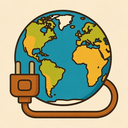
In the realm of digital iconography, few designs manage to encapsulate such a rich confluence of meaning and aesthetic elegance as an icon that seamlessly blends the thematic elements of Geography, Plug, and Classic. This meticulously crafted symbol transcends mere visual representation; it becomes a narrative artifact, merging spatial awareness with technological connectivity and timeless design principles. The icon is not merely functional—it is an emblem of interconnection, discovery, and enduring style.
At its core, this icon draws heavily from the traditions of cartography and geographical representation. The primary shape is a stylized globe—rounded and proportionate with a balanced curvature that evokes both precision and familiarity. However, rather than presenting a fully detailed world map, the icon uses minimalistic line work to trace key continental outlines: Africa, Eurasia, North America, South America, Australia, and Antarctica are subtly hinted at through elegant strokes of varying thickness. These lines are not drawn with exact geographical accuracy but instead follow a curated artistic approach that emphasizes recognition over realism—a technique common in classic emblem design.
The globe is rendered using a two-tone color scheme: deep navy blue for the oceanic regions and earthy terracotta for landmasses. This choice of palette is both nostalgic and intentional—reminiscent of mid-20th-century travel posters, nautical charts, and vintage atlas illustrations. The interplay between these colors creates a visual harmony that evokes a sense of journey, exploration, and global unity. At the center of the globe lies a small but distinct red dot—an intentional focal point indicating either a reference location or an access point to geographical data. This dot symbolizes not just place, but purpose: it is where information begins and where connections are made.
Emerging from the southern hemisphere of the globe—a region historically associated with exploration and new frontiers—sprouts a sleek, minimalist plug. This element is not a literal electrical socket but rather an abstract representation of connectivity, integration, and data transfer. The plug is shaped like a three-pronged connector in profile view: two horizontal prongs extend outward with smooth curves, while the central ground prong tapers downward into the globe itself.
What makes this design particularly sophisticated is how seamlessly the plug integrates with the geographical form. Instead of appearing as an afterthought or disjointed add-on, it appears to grow organically from within the earth's surface—suggesting that data and connectivity are not external forces but deeply rooted in our understanding of place and space. The plug’s body is rendered in a cool metallic silver, contrasting with the warm tones of the globe. This contrast reinforces its role as an interface—an active bridge between physical geography and digital networks.
Crucially, the plug does not disrupt the icon’s balance or symmetry; instead, it introduces dynamic tension. The lines of the plug subtly echo those of longitude and latitude lines on a map, creating an invisible dialogue between cartographic geometry and electrical engineering. This fusion suggests that in today’s world, geographical knowledge is no longer passive—it must be actively accessed, updated, and shared through interconnected systems. The plug becomes a metaphor: we don’t just study geography—we plug into it.
Perhaps the most defining characteristic of this icon is its adherence to Classic design principles. From its clean lines and balanced proportions to its restrained use of color and form, every element reflects a design philosophy rooted in timelessness rather than trend. The icon avoids gradients, shadows, or excessive ornamentation—hallmarks of modern flat or skeuomorphic styles that quickly become outdated.
The fontless nature of the icon further enhances its classical appeal; no text is present to distract from its symbolic purity. Its design language speaks through form alone—a hallmark of early 20th-century emblems, such as those seen in railroad insignia, maritime flags, and international signage systems. These symbols were designed to be instantly recognizable across cultures and languages—precisely the goal of this icon.
Moreover, the proportions are carefully calculated: the globe occupies approximately 70% of the icon’s height, with the plug extending just beyond its base. This creates a sense of grounded stability—an impression that while technology may evolve, our understanding of geography remains foundational. The overall silhouette is circular and symmetrical in appearance when viewed from afar, reinforcing ideals of unity and completeness.
In combining Geography, Plug, and Classic, this icon becomes more than a visual cue—it transforms into a conceptual statement. It speaks to our modern world: one where global understanding is not passive, but actively pursued through digital access; where physical space and virtual networks converge; and where design must endure beyond fleeting fads. The icon stands as both a reminder of our planet’s vastness and an invitation to connect with it—literally, through the plug, and figuratively, through knowledge.
Whether used in educational software, geographic information systems (GIS), or travel applications, this icon embodies the essence of discovery in the digital age. It is not just a symbol of where we are—but how we get there. And in doing so, it reclaims the classical ideal: design that is beautiful, meaningful, and lasting.
Create your own icon with our GoGPT AI prompt:
GoGPT