

Geography Plug Minimalist Free icon download
Download all to grab every PNG variant.
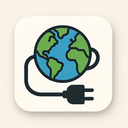
At the intersection of cartographic tradition and modern digital utility lies a singular icon that masterfully blends three distinct yet harmonious concepts: Geography, Plug, and Minimalism. This icon is not merely a visual element—it is a narrative in geometric simplicity. Designed with meticulous care for negative space, clean lines, and conceptual clarity, it encapsulates the essence of geographic information while suggesting connectivity—both literal and metaphorical—through the universal symbol of the plug.
Visually, the icon adheres strictly to minimalist principles. It features a crisp, monochromatic design in either pure white on a dark background or solid black on light canvas, emphasizing purity of form. The entire composition occupies no more than 24x24 pixels in its standard digital manifestation—a testament to its minimalist ethos. There are no gradients, textures, shadows, or ornamental embellishments. Instead, every line and shape serves a deliberate purpose: to communicate meaning with maximum efficiency.
The foundation of the icon is a stylized world map rendered in abstract form. Rather than depicting continents with geographical accuracy down to coastlines or political boundaries, the designer employs a reduced abstraction—two primary curved lines represent the northern and southern hemispheres, connected by a central horizontal band that suggests an equatorial line. This geometric approach aligns with minimalist aesthetics by stripping away superfluous detail while retaining recognizability. The continents are implied rather than illustrated: subtle protrusions along the curve of the sphere suggest Africa, South America, and Eurasia without rendering them explicitly. This abstraction allows viewers to instantly recognize the icon as geographical—yet it doesn’t overwhelm with cartographic complexity.
Intertwined with this globe-like form is a single plug element—a sleek, three-pronged electrical connector that emerges from the base of the earth representation. The plug is not a literal rendering; instead, it’s simplified into three angular, symmetrical prongs arranged in a triangular configuration. These prongs are seamlessly integrated into the lower edge of the globe's base, as if emerging naturally from its surface. This fusion of geography and technology symbolizes modern connectivity: the idea that geographic data—once isolated to paper maps or static atlases—is now dynamically connected through digital networks.
The integration between plug and globe is not arbitrary. The prongs subtly mimic the radial symmetry found in many cartographic projections, particularly the azimuthal equidistant projection used in many world maps. This deliberate alignment reinforces the icon’s conceptual depth: it suggests that geographical information is not static but powered, alive, and accessible—like a device plugged into a network of data streams. In this interpretation, the plug becomes more than an electrical connector; it is a metaphor for access—access to maps, location-based services, geospatial analysis tools, and real-time geographic information systems (GIS).
From a functional standpoint, the icon is designed for scalability and clarity across devices. Whether displayed on a smartphone screen or embedded in enterprise software dashboards, it remains legible and impactful. The lack of intricate details ensures that it doesn’t degrade when scaled down to 16x16 pixels, maintaining its integrity as an icon within navigation menus, data visualization platforms, or mobile applications related to geolocation services.
Its minimalist design also makes the icon highly adaptable. Because it avoids cultural or regional specificity—no borders are drawn, no nation-states are emphasized—it functions universally across diverse audiences. It speaks a language of symbols rather than words, transcending linguistic barriers while still conveying the core idea: geographic information powered by digital connectivity.
Furthermore, the color palette reinforces its minimalist identity. In most implementations, it appears in a single shade—typically #000 or #FFF—sometimes with a subtle gradient in larger formats to suggest depth without compromising simplicity. The absence of vibrant hues ensures that the icon remains understated and professional, suitable for use in serious applications such as scientific research dashboards, urban planning tools, environmental monitoring software, or navigation systems.
The emotional tone of the icon is one of calm efficiency. It evokes a sense of order and precision—qualities essential to both cartography and modern digital infrastructure. Viewers are not distracted by visual noise; instead, they are invited to focus on the symbolic interplay between Earth (geography) and connection (plug), framed within a minimalist aesthetic that values clarity above all.
In conclusion, this icon is a masterpiece of conceptual synthesis. It transforms complex ideas—geographic data, digital connectivity, and design purity—into a single, elegant symbol. By merging the timeless theme of geography with the modern necessity of technology (the plug), and executing it through a minimalist lens that celebrates restraint and function, this icon stands as a powerful representation of how design can elevate meaning through simplicity. It is not just an image; it is a statement about our world—interconnected, mapped, and perpetually powered by knowledge.
Create your own icon with our GoGPT AI prompt:
GoGPT