

Geography Robot Classic Free icon download
Download all to grab every PNG variant.
```html
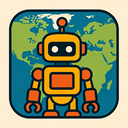
The icon in question is a masterful synthesis of three distinct yet harmoniously integrated themes—Geography, Robot, and Classic. It stands as a visual manifesto of the enduring relationship between human exploration and technological advancement. At first glance, the icon appears as a retro-futuristic emblem that evokes nostalgia while simultaneously projecting forward-looking innovation. The composition is balanced with precision—a hallmark of classic design principles—while its subject matter delves deep into the realms of global discovery and mechanical intelligence.
At the center of the icon lies a stylized, spherical representation that embodies Earth itself. This globe is not rendered in a modern, hyper-realistic manner but instead adopts a simplified, vintage aesthetic reminiscent of mid-20th-century cartography. The continents are outlined with clean, bold lines using muted earth tones—olive greens for forests and blues for oceans—echoing the color palettes found on old National Geographic maps or vintage world atlases. A subtle network of grid lines traces latitude and longitude, evoking a sense of geographical precision and intellectual order. These features underscore the icon’s core theme: Geography—not merely as a subject of study, but as an enduring human endeavor to map, understand, and navigate the world.
What transforms this classical globe into something far more dynamic is the presence of an intricate robotic framework subtly integrated into its structure. Instead of being a mere ornament or background detail, the robot element is woven seamlessly into the icon’s design. The sphere appears to be encased in a series of articulated metal segments, resembling mechanical joints and rivets reminiscent of 1950s science fiction illustrations—think classic robots from early comic books or vintage movie posters like "Metropolis" or "Forbidden Planet." These robotic elements are not overpowering; instead, they serve as both support and symbolic extension of the globe. They suggest that modern exploration is no longer limited to footprints on land or sails across seas, but has extended into the realm of automation, satellite navigation, and intelligent systems.
The robot’s form is abstract yet unmistakable. It takes shape through a series of geometric lines—hexagons, squares, and circular gears—that converge around the globe like an exoskeleton. Each segment appears to rotate slightly in a subtle animation (if digital) or suggests motion through implied angles in static versions. These components are polished silver with faint brushed textures, giving them a timeless mechanical elegance—a clear nod to classic industrial design from the mid-century modern era. The robot does not dominate the icon; rather, it complements and elevates it, symbolizing how robotics enhances geographical understanding: from autonomous rovers exploring Mars to AI-powered mapping systems that analyze satellite data in real time.
One of the most compelling aspects of this icon is its adherence to classic design principles. It follows symmetry, proportion, and balance—the golden ratio subtly shaping the distribution of elements. The color palette is restrained yet purposeful: deep navy blue for the background, warm gold for key outlines and accents, and crisp white highlights that suggest light reflecting off metallic surfaces. There are no excessive gradients or digital noise; every line serves a function. This minimalism echoes the design ethos of Bauhaus and Swiss typography—where form follows function, and clarity reigns supreme.
Even in its smallest iterations—on app icons or browser tabs—the icon retains its legibility. The globe remains distinguishable from the robotic frame, and each element contributes to a unified whole. This balance is crucial for usability across platforms, reinforcing the idea that classic design principles are not relics but enduring tools for effective communication.
Moreover, the icon invites deeper interpretation. It speaks to humanity’s historical quest to understand our planet—through ancient maps drawn by hand, through compasses and astrolabes—and how today’s geospatial technologies are carried forward by intelligent machines. The robot is not a replacement for human curiosity but an extension of it: a tireless explorer, processing data, charting courses, detecting patterns in climate shifts or tectonic movements. In this way, the icon becomes more than just a symbol—it becomes a narrative of continuity.
The fusion of Geography and Robot also hints at future possibilities. With climate change pressing global attention and geopolitical borders shifting under new technologies, the need for accurate geographic intelligence is greater than ever. This icon suggests that robots—whether drones collecting terrain data or AI systems modeling migration patterns—are essential allies in our ongoing exploration of Earth.
In essence, this icon stands as a monument to human ingenuity. It honors the past through its classic design language and reverence for geography, embraces the present with robotic sophistication, and points toward a future where technology enhances our understanding of the world. It is not merely an image; it is a story—a story of exploration, innovation, and timeless curiosity—told in lines, shapes, and silence.
```Create your own icon with our GoGPT AI prompt:
GoGPT