

Geography Robot Flat design Free icon download
Download all to grab every PNG variant.
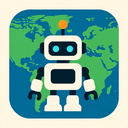
The icon in question is a meticulously crafted visual representation that seamlessly integrates the themes of Geography, Robotics, and Flat Design. At first glance, it presents a clean and modern aesthetic that immediately signals its digital origin—characteristic of contemporary UI/UX design trends. The composition harmonizes abstract cartographic elements with anthropomorphic robotic features through the minimalist principles of flat design. This convergence results in an icon that is not only visually striking but conceptually rich, making it ideal for applications ranging from educational platforms and geographic information systems (GIS) to robotics education tools and STEM-focused interfaces.
At the core of the icon lies a stylized globe, rendered in a flat design language with no gradients, shadows, or intricate textures. The globe is composed of clean geometric shapes—primarily circular forms segmented into abstract continents using simplified outlines. These continental shapes are not realistic representations but rather symbolic approximations that capture the essence of Earth's landmasses without overcomplicating the visual narrative. The color palette is intentionally limited: a soft, muted blue for oceans and a warm earth tone for landmasses, with subtle variations in saturation to suggest depth while maintaining flatness. This cartographic abstraction serves as both a nod to traditional geography and an invitation to interpret the icon through a futuristic lens.
What transforms this otherwise conventional geographic symbol into something truly unique is the integration of robotic elements. Emerging from the northern hemisphere of the globe is a sleek, humanoid robot torso that appears to be constructed from metallic plates resembling circuit boards and mechanical joints. The robot’s form is strictly geometric: angular shoulders, a cylindrical neck, and a head shaped like an elongated hexagon with two glowing circular lenses for eyes—symbolizing artificial intelligence and machine vision. These features are rendered with sharp lines and precise angles, adhering to the flat design philosophy of avoiding realistic shading or perspective effects.
The robot's design is not merely decorative; it is conceptually significant. Its integration into the globe suggests a new era in geographic exploration—one where robots, drones, and AI-powered systems are central to data collection, mapping, and environmental monitoring. The robotic figure appears to be "reading" or "interpreting" the globe beneath it with its digital eyes, symbolizing intelligent analysis of spatial data. This interaction between machine and planet reinforces the idea that modern geography is no longer solely reliant on human surveyors but increasingly augmented by autonomous technology.
Further enhancing this fusion, small details in the icon reinforce both themes. The robot’s arms extend outward in a gesture of connection or analysis, with one hand gently touching a satellite orbiting above the globe—a stylized ring shape with three small dots representing communication nodes. This element underscores the technological infrastructure that supports modern geographic information systems and remote sensing applications. Additionally, faint grid lines—representing latitude and longitude—wrap around both the robot's torso and the globe, subtly bridging mechanical design with cartographic precision.
Color plays a crucial role in conveying meaning within this flat design framework. The primary hues are selected not for realism but for symbolic clarity: blue evokes technology and intelligence, while warm earth tones suggest connection to our planet. Accent colors—such as a soft yellow or pale green—are used sparingly on the robot’s lenses and the satellite nodes to highlight key features without disrupting the minimalist aesthetic. This restrained use of color ensures that all visual elements remain easily distinguishable even at small sizes, making the icon highly effective across various digital platforms, from mobile apps to desktop software.
From a technical standpoint, this icon exemplifies modern flat design principles: simplicity, scalability, and clarity. It uses consistent stroke weights (typically 2px), uniform corner radii on all shapes, and a grid-based alignment system that ensures symmetry and balance. The absence of drop shadows or bevels prevents visual clutter while enhancing legibility—critical attributes for icons used in user interfaces where space is limited.
In conclusion, this icon stands as a powerful visual metaphor: the convergence of human curiosity about our planet (Geography), technological advancement through robotics, and contemporary design sensibilities through flat aesthetics. It represents an evolving discipline where machines are not just tools but partners in understanding Earth’s complex systems. Whether used in educational software, research dashboards, or interactive maps, this icon communicates a forward-thinking vision of geography—one that is intelligent, automated, and visually elegant.
Create your own icon with our GoGPT AI prompt:
GoGPT