

Geography Satellite Cartoon Free icon download
Download all to grab every PNG variant.
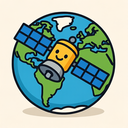
The icon in question is a vibrant, stylized representation that masterfully blends the academic precision of geography with the advanced technology of satellite imagery and the playful charm of cartoon artistry. At first glance, it presents an inviting visual language that appeals to both children and adults alike—a whimsical yet informative design that captures attention while conveying complex spatial information in an accessible manner. The central figure is a friendly, anthropomorphized satellite orbited by stylized Earth-like shapes, creating a dynamic composition that symbolizes global connectivity and geographic awareness.
At the heart of the icon is a cartoon-style satellite, rendered with rounded edges and exaggerated features that give it an almost playful personality. The body of the satellite is shaped like a smiling face—complete with wide, sparkling eyes made from circular lenses (representing optical sensors), a cheerful, upturned mouth that curves into a friendly grin, and antennae shaped like hair spikes or ears. These anthropomorphic traits immediately establish the cartoon character’s identity: an enthusiastic explorer of our planet’s surface. The satellite's body is rendered in metallic silver with subtle blue and white highlights to simulate reflective solar panels and a glossy finish, suggesting advanced technological sophistication while maintaining a lighthearted tone.
Surrounding the central satellite are several stylized globes or planetary segments, each representing different geographic regions. These globes are not exact reproductions of Earth’s continents but rather simplified, colorful interpretations that resemble cartoonish versions of landmasses—rounded shapes with exaggerated curves and vibrant hues. For instance, one globe features a bright green triangle representing a continent (perhaps South America), while another displays an orange square for Africa, both rendered in flat vector styles reminiscent of children's educational illustrations. Each segment is clearly labeled with fun, bold typography: “Europe,” “Asia,” “North America,” and so on—each label drawn in comic-style text balloons to emphasize the cartoon theme.
Connecting these geographic segments is a network of glowing blue lines that resemble satellite signals or communication pathways. These lines form an intricate web across the icon, symbolizing global data transmission, geographic mapping, and real-time satellite monitoring. The lines are not rigid or mechanical but rather wavy and fluid—like animated ribbons dancing between the continents—further reinforcing the playful cartoon aesthetic while maintaining technical relevance. At key junctions of these pathways, small icons appear: a tiny compass in red, a magnifying glass in yellow, and a flag in white—all serving as visual cues for geographic exploration, navigation, and discovery.
The background of the icon is not plain but rather painted with soft gradients that suggest outer space—deep blues fading into purples and blacks at the edges. Scattered across this cosmic backdrop are tiny stars and constellations in white, some animated to twinkle slightly when viewed on interactive platforms, adding a sense of motion and wonder. This space setting is essential to establishing the satellite’s role: it is not just observing Earth but actively engaged in mapping it from afar—highlighting the technological aspect of modern geography.
One particularly clever detail lies in the satellite’s "viewfinder" or lens, which shows a miniature cartoon world map projected within its circular eye. This inner image displays simplified versions of major geographic features: rivers as wavy lines, mountains as triangular peaks, and oceans as blue patches—rendered with the same cartoony flair throughout the icon. This self-referential element reinforces the idea that satellite technology is a tool for visualizing geography in real time and making complex spatial data understandable.
Additionally, subtle motion effects or layered animations can be applied to bring this icon to life: for example, the satellite slowly rotates on its axis, the globe segments gently drift and shimmer, and the connecting lines pulse with soft light. These enhancements make it suitable for interactive educational apps or websites where users are encouraged to explore global themes through fun and engaging visuals.
Ultimately, this icon is a perfect synthesis of three distinct concepts: the scientific discipline of geography, the technological marvel of satellite observation, and the joyful imagination of cartoon design. It transforms abstract ideas—remote sensing, cartography, planetary data—into an approachable visual narrative that invites curiosity and learning. Whether used in a classroom setting for children or as a modern interface element on a geographic information system (GIS) platform, this icon succeeds in making geography feel accessible, exciting, and delightfully whimsical—all while accurately representing the crucial role satellites play in understanding our planet.
Create your own icon with our GoGPT AI prompt:
GoGPT