

Geography Satellite Classic Free icon download
Download all to grab every PNG variant.
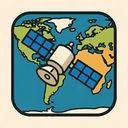
The icon under description is a masterful representation of three powerful concepts—Geography, Satellite technology, and Classic design—melded into a single visual symbol that resonates with both historical reverence and modern innovation. It stands as a testament to how the evolution of human understanding of the Earth has been shaped by scientific advancement, technological ingenuity, and enduring aesthetic principles.
At its core, this icon embodies Geography, the foundational discipline that explores Earth's physical features, climate patterns, cultural landscapes, and spatial relationships. The central element of the icon is a stylized globe—rounded and proportionally balanced—rendered in a way that evokes both accuracy and artistic elegance. Its surface is intricately detailed with subtle lines representing meridians and parallels, subtly highlighting the grid system used by cartographers for centuries. A series of continents are clearly outlined in earthy hues: deep green for forests, gentle blue for oceans, and soft brown for deserts—colors that mirror the natural palette of our planet while remaining artistically harmonious. The globe is not a mere illustration but a symbolic gateway to spatial awareness, inviting viewers to reflect on how humanity has mapped and understood its home over time.
Surrounding the globe is a prominent circular orbit—thin yet defined—that signifies Satellite technology. This orbit traces the path of an artificial satellite that appears as a sleek, angular shape moving along its elliptical trajectory. The satellite itself is rendered in minimalist form: a geometric cube with solar panels extending like wings and antennae reaching outward, conveying functionality without sacrificing elegance. The design choice to make the satellite slightly smaller than the globe emphasizes its role as an observer rather than a central figure—representing how satellites provide invaluable data from above while Earth remains the primary subject of study. Its reflective surface glimmers subtly, suggesting modern materials such as polished aluminum or titanium, often used in actual spacecraft. The orbit is not static; it suggests motion and continuity—echoing the constant revolution of satellites around our planet, delivering real-time imagery that fuels weather forecasting, environmental monitoring, and global navigation systems.
What sets this icon apart from modern digital representations is its Classic character. The design draws clear inspiration from mid-20th-century cartography and early satellite imagery aesthetics. It features clean lines, balanced symmetry, and a monochromatic or limited color palette reminiscent of vintage maps from the 1950s and 60s—eras when geographic exploration transitioned from ground-based surveys to space-based observation. The font used for any accompanying text (if present) would be serif-based—perhaps something akin to Times New Roman or Baskerville—adding an air of permanence and tradition. The overall composition adheres to principles of classical design: harmony, proportion, and restraint. No flashy gradients or complex animations are present; instead, the icon relies on thoughtful placement and timeless visual language.
Furthermore, the icon's background is intentionally understated—a soft parchment-like texture or a faintly shaded gray—adding a tactile feel that evokes old-world mapmakers' workshops. This choice reinforces its classic identity while grounding it in historical context. The absence of digital effects like shadows or glows ensures that the focus remains on form and meaning rather than spectacle.
Functionally, this icon serves as a powerful symbol across various platforms: educational websites, geographic information systems (GIS), navigation apps, science museums, and academic publications. It conveys not just the technical aspects of satellite observation but also the intellectual journey of understanding Earth through geography. Its timeless design allows it to remain relevant regardless of technological shifts—much like how classical maps from centuries ago still inspire awe and curiosity today.
In essence, this icon is more than a visual element; it is a narrative. It tells the story of human curiosity—from ancient explorers charting coastlines with compasses and astrolabes to modern scientists launching satellites that peer down at Earth with unprecedented precision. It bridges past and future, science and art, tradition and technology. By integrating Geography as its thematic core, Satellite as its technological metaphor, and Classic as its aesthetic soul, the icon becomes a universal emblem of our enduring quest to understand the world we inhabit—and to do so with both precision and grace.
In an age saturated with fleeting digital graphics and ephemeral design trends, this icon stands as a quiet revolution: a reminder that true visual power lies not in complexity but in clarity, balance, and timelessness.
Create your own icon with our GoGPT AI prompt:
GoGPT