

Geography Satellite Flat design Free icon download
Download all to grab every PNG variant.
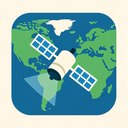
The icon is a meticulously crafted representation of geographical data through the lens of modern digital aesthetics. At its core, it embodies the intersection of three powerful concepts—Geography, Satellite imagery, and Flat design—each contributing to a cohesive visual language that communicates complex spatial information with clarity and elegance. This icon serves not only as a graphical element in digital interfaces but as an emblematic symbol of our interconnected world and humanity’s ongoing quest to understand Earth’s diverse landscapes through advanced technological means.
Visually, the icon adheres strictly to the principles of flat design, eschewing gradients, shadows, or intricate textures in favor of clean lines, bold shapes, and a minimalist color palette. This design philosophy prioritizes functionality and user experience by reducing visual noise and allowing users to focus on the core meaning of the icon. The absence of depth cues such as drop shadows or bevels creates a two-dimensional appearance that feels contemporary, scalable, and perfectly suited for both small mobile screens and large dashboard displays.
At the center of the icon lies a stylized satellite—depicted as a geometrically simplified orb with three distinct solar panels extending symmetrically from its sides. The satellite is rendered in a uniform, vibrant blue color (#007BFF), symbolizing technology, innovation, and global connectivity. Its shape is almost polygonal in nature, composed of sharp-edged triangles and rectangles that reinforce the flat design aesthetic while simultaneously suggesting motion and precision. The symmetry of the satellite reflects balance and reliability—key attributes associated with space-based observation systems that provide consistent geographical data across continents.
Surrounding the satellite is a circular orbit path drawn in a lighter shade of blue (#5bc0de), representing the satellite’s trajectory around Earth. This ring is not solid but rather composed of evenly spaced dots, evoking the idea of real-time tracking and continuous data collection. The use of discrete points instead of a solid line adds dynamism to the composition without compromising its flatness—each dot functions as a pixel in an abstract map, reinforcing the digital nature of satellite observation.
Below and slightly overlapping the satellite's orbit is a stylized representation of Earth itself. In true flat design tradition, Earth is depicted as a simplified two-dimensional sphere with no depth or dimensionality. The globe features four distinct landmasses—Africa, Europe, South America, and Australia—each colored in earthy tones such as forest green (#28a745) for lush areas and terracotta (#e6934b) for arid regions. These color choices are not meant to be geographically accurate but rather symbolic: they represent the diversity of Earth’s surface, from dense rainforests to vast deserts. The oceans are rendered in a soft sky blue (#00aaff), contrasting gently with the land masses and emphasizing their fluidity and continuity.
The integration of Geography into this icon is profound. It goes beyond mere visual representation; it encapsulates the very essence of geographical science—the study, mapping, and interpretation of Earth’s physical features, human settlements, climates, and ecosystems. This icon does not merely depict a satellite—it represents a powerful tool used in geographic information systems (GIS), climate modeling, disaster response planning, urban development studies, and environmental monitoring. Every dot along the orbit signifies data points collected from space: temperature readings, land use patterns, deforestation rates, or weather systems. In this way, the icon becomes a microcosm of global observation—where digital technology enables us to see our planet in ways previously impossible.
Moreover, the satellite’s position above Earth is not arbitrary. It suggests altitude and perspective—viewing the planet from above as a whole, rather than through individual regional lenses. This bird’s-eye view mirrors how modern geography operates: holistically, systemically, and data-driven. The flat design ensures that this global perspective remains accessible and intuitive to users of all backgrounds—educators, researchers, policymakers, travelers—all able to instantly recognize the icon's meaning without needing prior technical knowledge.
Color theory plays a crucial role in reinforcing the icon’s message. The blue tones evoke trust and intelligence; they are associated with science, technology, and calm precision. The green and terracotta landmasses suggest sustainability and ecological awareness—key concerns in contemporary geographical discourse. Together, these colors form a visual narrative that aligns with modern values: environmental stewardship, data transparency, and global cooperation.
In conclusion, this icon is far more than a simple image—it is a symbolic bridge between humanity’s desire to understand the world and the technological tools that make such understanding possible. Through its masterful blend of Geography, Satellite imagery, and Flat design, it communicates complex ideas with simplicity, elegance, and purpose. It stands as a testament to how modern iconography can encapsulate vast concepts within a single, scalable shape—making the wonders of our planet visible from space to every user at the touch of a screen.
Create your own icon with our GoGPT AI prompt:
GoGPT