

Geography Satellite Glassy Free icon download
Download all to grab every PNG variant.
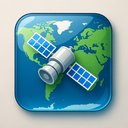
The icon in question is a masterful synthesis of three distinct yet interconnected themes: Geography, Satellite, and Glassy. At first glance, it appears as a sleek digital emblem that captures the essence of modern cartography through a futuristic lens. The central element is an abstract globe—a stylized representation of Earth—that serves as the foundation for this intricate visual narrative. Unlike traditional depictions of geographical maps with visible borders and labeled continents, this icon presents a fluid interpretation where geographical features are rendered not through lines and text, but through subtle gradients, translucent contours, and dynamic color shifts that suggest elevation changes, ocean depths, and landmass distribution with remarkable subtlety.
The globe itself is composed of multiple layered segments that give the impression of being crafted from tempered glass. This glassy aesthetic permeates every aspect of the design: from the smooth curvature to the reflective surface finishes. The surface is not flat or matte; instead, it possesses a high-gloss finish that mimics polished crystal or prismatic glass, capable of catching and refracting light in varying degrees depending on viewing angle. This reflective quality enhances depth perception and creates an illusion of three-dimensionality even on a two-dimensional screen. When illuminated—whether by ambient light or digital lighting effects—the globe appears to glow faintly from within, as though it contains a self-sustaining source of soft illumination, adding to its ethereal and almost otherworldly quality.
Integrated into the globe is a satellite motif that serves both functional and symbolic roles. Positioned slightly above the equatorial region of the glassy sphere, there is a small but prominent satellite orbiter—depicted as a sleek, angular spacecraft with streamlined wings and glowing navigation lights. Unlike traditional representations where satellites are mere dots in space, this one is highly detailed: it features segmented solar panels that extend symmetrically from its body, each panel reflecting faintly like glass itself. The satellite’s design echoes modern aerospace engineering with clean lines and precision geometry. What makes this element especially compelling is how it appears to be orbiting the globe not as a detached object but as an integral part of the Earth’s digital ecosystem—a visual metaphor for global connectivity, real-time data collection, and planetary monitoring.
The satellite does not float aimlessly in space. Instead, a delicate network of semi-transparent light trails connects it to various points on the globe. These trails resemble faint laser beams or energy streams that pulse gently with a soft blue-white glow. They symbolize data transmission, GPS signals, or real-time imaging feeds from orbit—key functions of modern satellite technology in geographical sciences. The trails are rendered with a glassy sheen, blending seamlessly into the overall aesthetic. Their curvature mirrors orbital paths and creates visual tension between the static sphere and the dynamic motion of space travel.
Geographically, every aspect of this icon is purposeful. The continents are not solid masses but suggested through subtle tonal variations—shades of blue-green for coastal zones, deep navy for oceanic trenches, and pale ochre for arid regions. Mountains appear as gentle undulations in the glass surface, their peaks catching light like facets on a gemstone. River systems are depicted as winding streams of translucent silver that flow across the globe’s surface with fluid precision. The entire planet seems to breathe—subtle ripples emanate from key geographic locations, representing seismic activity or weather patterns captured by satellite imaging.
Moreover, the glassy quality extends beyond appearance into symbolism. Glass conveys clarity, transparency, and precision—all essential qualities in geographical data visualization. In this icon, the glassy surface implies a clear view of Earth from above: no obstructions, no distortions. It suggests that through satellite technology and advanced geographic information systems (GIS), humanity can now see the planet with unprecedented accuracy and insight. The reflective nature also hints at introspection—encouraging viewers to consider their relationship with the Earth, their role in global monitoring, and the importance of preserving our environment.
Color choices further reinforce this thematic depth. A gradient palette transitions from deep cobalt at the poles to vibrant cyan near the equator, evoking oceanic expanses and atmospheric layers. Accents of gold and silver are used sparingly but effectively—on satellite components, light trails, and edge highlights—to suggest technological sophistication and high-definition imaging. The overall effect is both serene and cutting-edge: peaceful in its aesthetic harmony yet charged with the energy of innovation.
In conclusion, this icon masterfully unites Geography, Satellite technology, and a glassy design language into a single cohesive visual experience. It transcends mere illustration to become a symbol of humanity’s evolving relationship with Earth—observing from space, understanding through data, and envisioning the planet with clarity and reverence. Whether used in mapping software, scientific visualization platforms, or environmental awareness campaigns, this icon stands as a testament to how art and technology can converge to represent our shared world in ways both beautiful and meaningful.
Create your own icon with our GoGPT AI prompt:
GoGPT