

Geography Satellite Pixel art Free icon download
Download all to grab every PNG variant.
```html
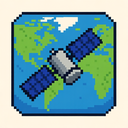
At the intersection of cartography, digital technology, and artistic expression lies a compelling visual artifact: the Geography Satellite Pixel Art Icon. This meticulously crafted icon serves as more than just a graphical symbol—it embodies the convergence of human curiosity about our planet with modern technological capabilities. Combining three powerful themes—Geography, Satellite imagery, and Pixel art—the icon represents both scientific exploration and creative digital heritage in a single, compact 16x16 or 32x32 pixel canvas.
From its inception as a concept to its realization as a visual metaphor, this icon draws deeply from the essence of Geography. Geography is the study of Earth’s physical features, human societies, and the dynamic interactions between them. The icon captures this multidimensional nature by visually representing Earth—not in abstract or stylized form but through identifiable geographical elements such as continents, oceans, mountain ranges, and coastlines. These elements are not rendered with realism but instead distilled into their most essential forms through the constraints of pixel art.
Central to the icon’s meaning is its representation of Satellite technology. Satellites orbiting Earth provide high-resolution images that allow scientists, urban planners, environmentalists, and researchers to monitor climate change, track natural disasters, analyze land use patterns, and explore remote regions. In this iconography, a stylized satellite appears hovering above the pixelated globe—typically depicted as a small geometric shape with solar panels extending like wings or antennae pointing upward. This satellite is not rendered with photographic accuracy but through the limited color palette and blocky forms characteristic of early video games and retro digital graphics.
The brilliance of this icon lies in how it harmonizes these three core elements: Geography, Satellite, and Pixel art. The pixel art style is not merely an aesthetic choice—it’s a fundamental component that reinforces meaning. The deliberate use of limited colors—typically blues for oceans, greens for landmasses, browns for mountains or deserts, and white or light gray for ice caps—mirrors the way early satellite images were processed and displayed in low-resolution formats. Each pixel is intentional; every color choice conveys information within a highly constrained visual space. This constraint forces artistic precision: geography must be simplified without losing recognizability, and satellite positioning must be clear even at a miniature scale.
For example, the continent shapes are exaggerated slightly to maintain legibility—Africa might be stretched to emphasize its distinctive triangular form, while South America’s curve is emphasized. Oceans are rendered as large expanses of deep blue with subtle gradients achieved through dithering techniques common in classic pixel art. Mountain ranges may appear as a series of dark green or brown pixels arranged vertically, suggesting elevation without detailed topography. The satellite itself might be depicted with a white or silver-colored body and two solar panels in contrasting hues, positioned at an angle to suggest orbital motion.
Moreover, the icon often includes subtle visual cues that hint at data transmission: small pixelated beams of light or pulses radiating from the satellite to the Earth’s surface—symbolizing how satellite data is relayed back to ground stations for analysis. These elements are carefully placed so as not to clutter the design but instead enhance its thematic depth. The entire composition adheres strictly to a 16x16 pixel grid, which challenges artists and designers to convey complex concepts with minimal visual noise—a true test of creative economy.
Functionally, this icon is ideal for digital applications related to geospatial technology: mapping tools, GIS software interfaces, environmental monitoring platforms, educational apps about Earth sciences, or even retro-style video games that incorporate real-world geography. Its nostalgic pixel art aesthetic appeals to fans of vintage computer graphics while simultaneously conveying cutting-edge satellite data in a digestible format. It is both a tribute to the past and a beacon for the future of geographical understanding.
In essence, the Geography Satellite Pixel Art Icon transcends mere decoration—it is a miniature narrative. Within its few hundred pixels, it tells the story of how humanity has come to see Earth from space, how we use technology to map and understand our planet’s complexity, and how digital art can preserve both scientific truth and creative spirit. It stands as a testament to the enduring human desire to explore, chart, and visualize the world—both physically and imaginatively—across time, scale, and medium.
In an age of hyper-realistic renderings and high-definition satellite images, this icon serves as a refreshing reminder that sometimes less is more. With its deliberate simplicity, rich symbolic meaning, and celebration of digital craftsmanship, the Geography Satellite Pixel Art Icon remains a powerful emblem of curiosity—the kind that begins with looking up at the sky and ends with understanding our place on Earth.
```Create your own icon with our GoGPT AI prompt:
GoGPT