

Geography Satellite Retro Free icon download
Download all to grab every PNG variant.
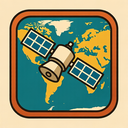
The icon under description is a masterful fusion of three distinct yet harmonious themes—Geography, Satellite, and Retro—that together create a visually rich and conceptually layered piece. This icon transcends mere visual representation; it becomes an artifact—a digital relic that bridges past and present while celebrating humanity’s enduring fascination with mapping the world. At its core, this icon embodies **Geography** through its intricate cartographic design. The central element is a stylized, circular map of the Earth rendered in a vintage topographical style. Unlike modern flat or angular representations, this globe appears as if hand-drawn on aged parchment using subtle gradients and faint contour lines that mimic the precision of 18th-century explorers' maps. Each continent is defined with gentle curves and soft shading, suggesting elevation and terrain without overwhelming the viewer. The ocean areas are rendered in a deep navy blue with faint wave patterns, evoking both depth and movement—reminding us that geography is not static but ever-changing. Intricate details such as mountain ranges labeled in faded script ("Himalayas," "Andes"), river systems flowing like delicate silver threads, and the polar ice caps outlined with a subtle white haze further emphasize its geographical authenticity. Surrounding this central globe is a **Satellite** element that anchors the icon's modernity. A stylized, retro-futuristic satellite orbits above the Earth’s equator in a perfect circular path—its form inspired by 1960s and 1970s space art and science fiction illustrations. The satellite itself is composed of geometric shapes: a cylindrical body with angular solar panels extending symmetrically on either side, reminiscent of early models like Explorer 1 or Sputnik. It features glowing amber lights along its edges, pulsing faintly as if in active orbit—suggesting real-time data collection from space. This satellite isn’t just an abstract shape; it’s a functional symbol of remote sensing and geographic information systems (GIS). Tiny antennae extend upward like antennae from old radios, reinforcing the retro aesthetic while subtly hinting at its technological purpose. The orbit path is drawn in a thin, wavy line with small dots marking intervals—evoking the analog data trails seen on vintage radar screens. The true genius of this icon lies in how it unifies these elements through a deliberate **Retro** design language that evokes nostalgia for mid-20th-century scientific illustration and space exploration. The entire composition is framed by a distressed border resembling aged wood or faded cardboard, with slight warping and imperfections to simulate decades of use. Colors are deliberately limited: sepia tones, dusty greens, muted blues, and soft golds dominate the palette—colors that suggest vintage maps found in forgotten libraries or retro science textbooks from the 1960s. The font used for any text elements—such as a subtle label reading "Earth View: 1972"—is a stylized serif typeface reminiscent of those used in old National Geographic covers or NASA press kits. The icon's lighting is soft and diffused, as if viewed through a foggy window or an old projector. There’s no harsh contrast—no digital glare. Instead, the light appears to emanate from within the satellite itself, casting gentle shadows on the globe below and creating depth without realism. This atmospheric quality enhances its retro charm by evoking how images were perceived in earlier decades—not as hyper-detailed simulations but as symbolic representations of knowledge and discovery. Even more subtly integrated is an aesthetic of imperfection that reinforces its retro character. The edges of the satellite are slightly blurred, the map lines waver faintly, and there’s a subtle grain texture across the entire image—like film stock from an old photograph. These details aren’t flaws; they’re intentional design choices meant to convey authenticity and time-worn wisdom. Beyond its visual elements, this icon carries symbolic weight. The satellite circling a vintage Earth suggests that modern technology—from space-based observation systems to digital cartography—was built upon centuries of geographical inquiry and human curiosity. It’s a poetic reminder that today’s high-resolution satellite imagery owes its existence to the painstaking work of early geographers who mapped the world with compasses, sextants, and intuition. In essence, this icon is more than just a visual symbol—it is a narrative. It tells the story of humanity’s journey from ground-bound exploration to orbital observation; from hand-drawn maps to digital satellites. It honors both scientific progress and artistic heritage by blending accurate geographical representation with the dreamlike elegance of retro futurism. Whether used in an educational app, a historical website, or a retro-themed design project, this icon stands as a testament to how art and technology can coexist—how the past informs the future, and how geography remains one of humanity’s oldest and most enduring quests for understanding our place in space. The fusion of **Geography**, **Satellite**, and **Retro** is not just thematic—it’s emotional, intellectual, and deeply evocative.
Create your own icon with our GoGPT AI prompt:
GoGPT