

Geography Shield Monochrome Free icon download
Download all to grab every PNG variant.
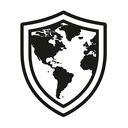
The icon under description is a meticulously crafted monochrome symbol that masterfully integrates the profound concepts of Geography, the protective essence of a Shield, and the minimalist aesthetic of a monochrome color palette. This emblem transcends mere visual representation—it embodies an ideological fusion between territorial identity, safeguarding principles, and artistic restraint. Every line, curve, and negative space within this icon serves as a deliberate expression of geographical significance while simultaneously conveying the strength and durability associated with protective shield symbolism.
At first glance, the icon presents a clean silhouette in pure black and white—a deliberate choice that underscores its monochrome nature. This absence of color is not an aesthetic limitation but rather a profound statement. The monochrome design strips away distractions, forcing the viewer to focus solely on form, proportion, and symbolic intent. It evokes timeless tradition—reminiscent of ancient seals, military insignia, and cartographic symbols from centuries past—where clarity and permanence were paramount. In this context, the lack of color becomes a powerful tool for emphasizing universality: this icon is not bound by nationality, political affiliation, or temporal trends. It speaks a language understood across borders and generations.
The foundational structure of the icon resembles an abstract yet recognizable shield—its silhouette forming a robust, slightly elongated oval with rounded edges at the top and a pointed base. This shield-like form immediately triggers associations with defense, heritage, sovereignty, and protection. Yet rather than being a literal depiction of medieval armor or national emblems, this shield is deeply embedded in geographical symbolism. The central element within the shield is a stylized world map rendered in fine black lines against a white background—essentially an abstract cartographic representation that suggests both global connectivity and regional specificity.
This geographical component is not a random collection of continents but instead features a deliberate, balanced composition. The outline of the Earth’s landmasses is simplified yet accurate: North America, South America, Europe, Africa, Asia (with its distinctive Eurasian peninsula), and Australia are rendered in an elegant schematic style. However, rather than filling the continents with solid color—a common technique in traditional maps—each landmass is defined by thin black lines that follow their natural contours. These lines converge at key geographic points: the equator forms a horizontal band across the center of the shield; meridians and parallels are subtly integrated as intersecting gridlines, not to indicate precise coordinates but rather to suggest cartographic precision and spatial awareness.
Interestingly, certain geographical features are emphasized through intentional distortion or magnification. The Mediterranean region—historically a crossroads of civilizations—is slightly enlarged, its coastal outlines more pronounced. Similarly, the Arctic Circle is subtly indicated with a dashed line encircling the northern portion of the globe within the shield. These details do not alter geographic accuracy but elevate symbolic meaning: they emphasize historical significance, environmental vulnerability, and geopolitical importance—all central themes in contemporary geographical discourse.
At the heart of this geographical representation lies a small, perfectly centered dot—a symbol of origin, center point, or focal point. This dot may represent the North Pole or an arbitrary but significant location that serves as the icon’s symbolic epicenter. It is not merely decorative; it functions as a visual anchor, drawing attention to balance and perspective. In this way, geography is not portrayed as static territory but rather as a dynamic network of relationships: between continents, cultures, climates, and ecosystems.
The shield’s border—though unobtrusive—is reinforced with subtle diagonal lines that suggest strength and resistance. These lines are not rigid or militaristic; instead, they echo the natural patterns seen in geological strata or tectonic plate boundaries. This design choice deepens the icon’s connection to geography by reminding viewers that Earth itself is a constantly evolving entity, shaped by both natural forces and human interaction.
Throughout its composition, the monochrome scheme reinforces unity and focus. The consistent use of black lines on a white ground creates high contrast and visual clarity—essential for recognition across scales. Whether rendered at 16 pixels or displayed on a monumental banner, the icon remains legible and meaningful. This scalability is vital in geographical applications: from digital maps to physical signage, from academic publications to international treaties.
In sum, this monochrome icon stands as a powerful synthesis of three core concepts: Geography, which informs its cartographic essence; the Shield, which imbues it with protective symbolism and structural integrity; and the deliberate choice of a Monochrome palette that enhances clarity, timelessness, and universality. It is not merely an image but a philosophical statement—a visual manifesto about how we understand our planet, protect its diverse regions, and preserve the enduring legacy of human connection to place.
Create your own icon with our GoGPT AI prompt:
GoGPT