

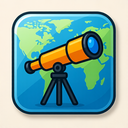
Geography Telescope Glassy Free icon download
Download all to grab every PNG variant.
```html
Imagine an icon that transcends mere visual representation—it becomes a symbol of human curiosity, the vastness of our planet, and the clarity with which we perceive both distant celestial bodies and intricate terrestrial landscapes. This is not just any emblem; it is a meticulously crafted fusion of three distinct yet harmoniously interwoven concepts: Geography, Telescope, and Glassy. Each element contributes to an icon that embodies the spirit of exploration, scientific precision, and aesthetic sophistication.
The central focus of the icon is a sleek, cylindrical telescope mounted on a tripod base. The telescope is not rendered in a crude or cartoonish manner but instead depicted with technical accuracy and refined artistry. Its barrel is crafted from brushed metallic gray material with subtle reflective highlights, suggesting durability and scientific utility. However, what makes this icon truly stand apart is the way the lens elements of the telescope are designed: each lens appears to be made of glassy material—transparent, smooth, and shimmering under a soft light source.
The lenses themselves are not ordinary glass but possess a dynamic glassy quality that reflects faint gradients of sky blue and deep space black. This optical illusion gives the impression that the telescope is both observing Earth's surface from above and peering into distant galaxies simultaneously. The glassy finish of the lens elements captures light in such a way that they seem to absorb and refract colors from their surroundings, creating a mesmerizing visual effect—like looking through a pane of crystal that reveals multiple dimensions at once.
Surrounding the base of the telescope, subtle yet deliberate geographic elements emerge. The tripod legs are shaped like stylized mountain ranges—each contour echoing real-world topographical features such as the Andes, Himalayas, or Rockies. These peaks are not merely decorative; they serve as a direct visual nod to Geography. The terrain beneath the telescope is rendered in a layered, translucent manner: thin lines indicate rivers, mountain ridges rise gently from the ground, and tectonic plate boundaries are subtly outlined in faint gold hues. Even continents can be discerned in miniature form on the baseplate—Africa, Eurasia, North America—all intricately detailed but reduced to an abstract representation that complements rather than overwhelms the main focal point.
What elevates this icon from a simple illustration to a profound metaphor is how these geographic features seem to rise up through the glassy lens of the telescope itself. As if gravity and perspective are inverted, miniature landmasses appear suspended within the transparent refractive surface of the primary lens. A small island floats in mid-air within the glass, connected by invisible threads to other floating archipelagos—symbolizing not only geographic connection but also how our perception of Earth is shaped by observation and technology. It’s as though we are using a telescope not just to see stars, but to better understand our own world from an elevated perspective—just like satellite imagery or geographic information systems (GIS) do.
The glassy quality extends beyond the lenses. The entire icon emits a soft luminosity, as if it were illuminated from within. This glow is not harsh or artificial; instead, it mimics the natural reflection of sunlight on water or polished crystal, reinforcing the idea of clarity and insight. At certain angles, viewers may perceive faint distortions in the light—similar to atmospheric refraction seen through a high-powered telescope lens—further enhancing the sense of depth and scientific authenticity.
Even minor details reinforce these core concepts. The tripod base includes tiny engraved coordinates (e.g., 40.7128° N, 74.0060° W), referencing New York City but symbolizing any point on Earth—reminding us that every location is a potential observation site for both planetary geographers and stargazers alike. The telescope’s focusing mechanism features a ring marked with geographic symbols: compass points, meridians, and latitudes—all subtly integrated into the design.
Ultimately, this icon represents more than just a tool or an image—it is a philosophical statement. It speaks to the unity between Earth and cosmos, between human-made instruments and natural wonder. The glassy transparency symbolizes clarity of vision—both literal (in optical precision) and metaphorical (in understanding our place in the universe). The telescope, an instrument of distant discovery, becomes a lens for interpreting geography with new depth. And the intricate, layered representation of geography shows that our planet’s complexity is not separate from our cosmic curiosity; rather, it is deeply connected to it.
In design philosophy, this icon serves as a beacon for educational tools, geographical software interfaces, astronomy apps, and scientific research platforms. Its fusion of realism and symbolism makes it instantly recognizable yet endlessly interpretable. It invites the viewer not only to look—through the telescope—but also to think: about how we map our world, how we explore beyond it, and how clarity—achieved through glassy precision—is essential to all true discovery.
```Create your own icon with our GoGPT AI prompt:
GoGPT