

Geography Train Glassy Free icon download
Download all to grab every PNG variant.
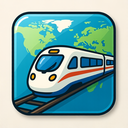
The icon under examination is a masterful synthesis of three distinct yet harmoniously integrated concepts: Geography, Train, and Glassy. At first glance, it appears as a sleek and modern emblem that captures the essence of movement across vast landscapes while simultaneously evoking the clarity and transparency associated with glass. This intricate design serves not only as an aesthetic symbol but also as a functional representation of modern transportation systems navigating complex geographical terrains with precision and elegance.
At its core, the icon is shaped like a stylized train—specifically, a high-speed rail vehicle—but rendered with an abstract, minimalist approach that emphasizes form over realism. The train's outline is smooth and fluid, suggesting speed without sacrificing structural integrity. Its elongated body tapers at both ends to create an aerodynamic profile reminiscent of contemporary maglev or bullet trains used in advanced transportation networks around the world. However, rather than depicting the train in metallic hues or traditional industrial colors, this icon employs a transparent, reflective surface that gives it a glassy quality—one that seems to refract and distort light in subtle ways depending on viewing angle.
The "glassy" aspect of this icon is particularly striking. The entire structure appears to be crafted from tempered, translucent glass—possibly an advanced composite material with iridescent properties. When light hits the surface, it creates a shimmering effect that mimics how sunlight glances off a modern train window or a high-rise building’s façade. This glassy texture is not merely decorative; it symbolizes clarity of vision and insight into spatial relationships—core tenets of geography as both an academic discipline and practical tool for understanding Earth's surface. The transparency allows viewers to see through the train, revealing intricate geographic features embedded within its form, such as contour lines, riverbeds, mountain ranges, or even latitude/longitude grid patterns.
These embedded geographic elements are what elevate the icon beyond a simple transportation symbol. Running along the length of the glassy train are delicate yet precise representations of topographic data: thin golden lines denote elevation changes, while blue filaments trace natural waterways like rivers and lakes. Subtle gradients in transparency suggest terrain depth—more opaque where mountains rise, more translucent where plains stretch outward. Even political boundaries are subtly hinted at through faint borders that weave through the train’s body, indicating how infrastructure projects often cross regional or national divisions. This integration of geography into the very structure of the train underscores a central theme: modern rail systems are not isolated artifacts but vital connectors within larger spatial networks shaped by human activity and natural landscapes alike.
Furthermore, the glassy surface reflects its surroundings in a dynamic way, much like how geographic information systems (GIS) visualize data from multiple perspectives. From one angle, the icon might appear to be a sleek silver train gliding through an abstract landscape. From another, it reveals a mosaic of country borders and elevation contours beneath its surface—a metaphor for the invisible infrastructure that enables global connectivity. This reflective quality also alludes to the concept of transparency in governance and data access—key issues in contemporary geographic research, urban planning, and transportation policy.
What makes this icon truly exceptional is how it merges movement (the train), spatial understanding (geography), and material innovation (glassy) into a single cohesive visual language. It embodies the idea that modern travel is not just about physical transit but also about gaining deeper insight into the world we inhabit. The glassy nature of the train suggests a future where transportation systems are transparent in their environmental impact, socially inclusive, and technologically advanced—all hallmarks of sustainable geographic development.
In conclusion, this icon transcends its functional role as a graphical symbol. It stands as a conceptual artwork that encapsulates the intersection of human ingenuity and Earth's complex geography. The train is no longer just a mode of transport; it becomes an instrument for exploration, discovery, and understanding. Through its glassy surface, it invites us to look deeper—not only at the paths we travel but also at the world we traverse. In doing so, it exemplifies how design can serve both aesthetic and intellectual purposes in our increasingly interconnected planet.
Create your own icon with our GoGPT AI prompt:
GoGPT