

Geography Tree Pixel art Free icon download
Download all to grab every PNG variant.
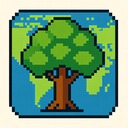
At first glance, this icon appears to be a modest square of 32x32 pixels—a digital relic from the golden age of pixel art. Yet upon closer inspection, it reveals itself as a deeply symbolic and intricately crafted representation that masterfully weaves together three pivotal themes: Geography, Tree, and the nostalgic charm of Pixel Art. This small but powerful image is not merely decorative; it functions as a microcosm of Earth’s natural and human-made landscapes, capturing both ecological significance and spatial awareness through the deliberate use of limited color palettes, grid-based design, and digital minimalism.
The central element of the icon is a stylized tree—its form rendered in crisp, geometric precision. The trunk is composed of four vertical pixels in varying shades of brown (from #8B4513 to #A0522D), giving it a sense of depth and dimension despite its two-dimensional nature. From this sturdy base, the canopy branches out into a symmetrical pattern made up of 16 pixels arranged in a circular burst. Each pixel is carefully placed to suggest leaves: dark green (#006400), medium green (#32CD32), and light lime (#ADFF2F) are used to simulate sunlight filtering through foliage. The result is not a realistic tree, but rather an abstracted, symbolic interpretation—a perfect fusion of organic form and digital simplicity.
However, what elevates this icon beyond mere visual appeal lies in how the Geography of the Earth is embedded within its design. If one looks closely at the base of the tree’s trunk, it does not sit on a plain ground plane. Instead, beneath and around it, there are subtle pixel patterns suggesting continents and landmasses—though only fragments are visible due to the icon’s small scale. Using a palette of blue for oceans (#0000FF), green for landforms (#228B22), and white for snowcaps or mountain peaks (#FFFFFF), the designer has incorporated a miniature world map. The tree is rooted firmly in what appears to be North America (noted by its continental shape and position relative to the central pixel grid). This geographical anchoring transforms the tree into more than just a plant—it becomes a symbol of life, growth, and continuity within specific geographic contexts.
The pixel art technique is not simply an aesthetic choice; it is fundamental to how the icon conveys meaning. The 32x32 grid forces every pixel to carry significance. There are no gradients or soft edges—only solid blocks of color that contribute to a greater narrative. The tree’s branches, for instance, do not curve naturally but instead extend in straight lines at 45-degree angles, mimicking the blocky geometry of classic video games from the 8-bit era (such as those found on the NES or Game Boy). This intentional stylization pays homage to retro gaming while also reinforcing themes of digital representation and data visualization. In this context, geography is not just about physical locations—it’s about how we perceive and represent space in a digital world.
Moreover, the choice to depict a tree within such a confined space underscores an important message: even small organisms have global significance. Trees are key indicators of ecological health, carbon sequestration, and biodiversity. By placing this single tree at the center of a miniature Earth map—its roots touching landmasses and its canopy reaching upward—it becomes a visual metaphor for sustainability. The pixelated nature of the icon further enhances this idea: just as each pixel contributes to a larger image, every individual action matters in preserving our planet’s geography and natural resources.
Color choice is another critical element tied to all three keywords. Green dominates the design—not only for the tree but also for landmasses—symbolizing life, renewal, and environmental balance. Blue represents water bodies, emphasizing Earth’s interconnectedness through oceans and rivers. The limited palette of 8–10 colors (a hallmark of authentic pixel art) ensures clarity even at small sizes, making the icon readable on mobile interfaces or low-resolution screens. This technical constraint becomes a creative strength: simplicity leads to universality.
Functionally, this icon could serve multiple purposes. It might appear in environmental education apps as a visual marker for reforestation projects. It could represent eco-friendly cities in urban planning software, where each pixel tree symbolizes green spaces across different regions. In gaming or interactive storytelling platforms, it may mark an area rich in natural resources or a sacred forest tied to cultural geography.
In essence, this icon transcends its modest dimensions. Through the lens of Geography, it reminds us of Earth’s physical and ecological systems. Through the symbol of the Tree, it evokes life, resilience, and environmental stewardship. And through its execution in Pixel Art, it celebrates digital craftsmanship and the enduring power of minimalism. It is a small image with a vast story—a testament to how meaning can flourish even within strict boundaries.
In an age of high-definition graphics and immersive realism, this icon stands as a quiet yet powerful reminder: sometimes, the most profound messages are conveyed not by complexity—but by simplicity, intentionality, and the careful placement of every single pixel.
Create your own icon with our GoGPT AI prompt:
GoGPT