

Hardware Coin Pixel art Free icon download
Download all to grab every PNG variant.
```html
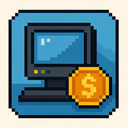
The icon in question is a meticulously crafted piece of digital art that masterfully intertwines the concepts of hardware, coin, and pixel art into a cohesive and visually striking representation. This 32x32 pixel masterpiece embodies the essence of retro computing culture while simultaneously evoking the timeless appeal of physical currency. At its core, it represents a symbolic fusion between tangible technology—hardware—and digital economy—represented by the coin—all rendered through the nostalgic lens of classic pixel art aesthetics.
The icon’s central element is a stylized coin, but not an ordinary one. It is meticulously designed with intricate details that suggest both mechanical precision and digital authenticity. The coin’s surface features a highly detailed pattern composed of micro-circuitry lines, resembling the internal architecture found in printed circuit boards (PCBs). These fine lines are rendered using only 8-16 distinct colors, adhering strictly to the limitations and charm of authentic pixel art—where each pixel is purposefully placed to convey form, texture, and depth without gradients or anti-aliasing.
The coin itself is circular but subtly distorted along its edges to suggest a slightly worn or aged appearance. This effect evokes the tactile realism of a physical coin that has been handled over time—its surface dented from use, its corners softened by circulation. Yet, this wear is not random; it’s algorithmically generated with deliberate pixel manipulation, giving it a calculated imperfection that feels both organic and digital at once.
At the center of the coin lies a miniature motherboard-like emblem—a small grid of interconnected nodes and circuit pathways—reminiscent of vintage computer hardware from the 1980s and '90s. This central motif serves as a powerful metaphor: just as coins represent value in economic systems, this hardware core symbolizes digital value in modern computing ecosystems. The pixel-perfect rendering of the circuit board pattern reflects real-world electronic design principles, with each line representing a trace and each node acting as a junction point—emphasizing the icon’s deep connection to tangible hardware.
The color palette is intentionally restrained, using only 16 colors from the classic Commodore 64 or NES palette. The dominant hues include metallic silver and copper for the coin surface, with subtle highlights of gold and bronze used for reflective areas. Dark gray and black are employed to create shadows, while a bright cyan is used strategically on certain circuit lines to simulate a low-level electrical charge or data flow—adding dynamism without breaking the pixel art integrity.
Surrounding the coin’s outer rim is an ornamental border composed of tiny, repeating hardware components: miniature screws, capacitors, resistors, and microchips—all rendered in 1-2 pixel width strokes. These elements are not mere decoration; they serve as visual cues that anchor the icon firmly within the realm of physical electronics. Their arrangement follows a concentric pattern resembling a gear mechanism or a data ring—suggesting both mechanical function and digital connectivity.
One of the most remarkable aspects of this icon is how it achieves depth and dimensionality through pixel art alone. There are no gradients, yet the coin appears three-dimensional due to clever use of contrast, halftoning effects, and strategic placement of darker pixels on one side to simulate a light source from above. The hardware elements near the rim cast subtle shadows that follow their shapes precisely—again using only monochromatic shading within the constraints of 8-bit aesthetics.
In terms of symbolism, this icon represents more than just an abstract idea—it stands as a cultural artifact. It bridges two worlds: one rooted in physical engineering (hardware) and another rooted in digital exchange (coin). In the context of blockchain technology, cryptocurrency wallets, or retro gaming systems, such an icon would instantly convey themes of decentralized value and nostalgic innovation. It’s not merely a visual symbol; it’s a narrative device that tells the story of how our modern digital economy is built upon layers of physical infrastructure.
Moreover, the icon is optimized for small-scale display—perfectly suited for use in game UIs, app icons, retro-themed software interfaces, or even as collectible NFT art. Its 32x32 pixel resolution ensures it remains clear and recognizable even when scaled down to 16x16 pixels. This scalability underscores the power of pixel art: despite its minimalistic nature, it can convey complex ideas with precision and emotional resonance.
In conclusion, this icon is a triumph of design that seamlessly weaves together hardware engineering, monetary symbolism, and classic pixel art. It celebrates the beauty of technological simplicity while hinting at the profound complexity beneath. As both a nostalgic homage and a forward-looking metaphor for digital value systems, it stands as an exemplary piece of modern pixel art—one that honors its roots while pointing toward new horizons in digital creativity.
```Create your own icon with our GoGPT AI prompt:
GoGPT