

Hardware Key Origami Free icon download
Download all to grab every PNG variant.
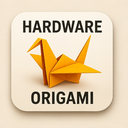
The icon in question is a masterful synthesis of three seemingly disparate concepts—hardware, key, and origami—crafted into a single symbol that transcends its individual components. At first glance, the icon presents itself as an intricate geometric form with clean lines and precise symmetry. Its central element resembles a stylized mechanical key made from metallic-gray tones, suggesting durability and functionality—a hallmark of hardware design. However, upon closer inspection, this key is not solid metal but instead constructed from layered paper-like surfaces that appear to fold seamlessly into one another like a piece of origami art.
The integration of hardware is evident in the icon’s foundational structure and material representation. The key’s body is rendered with subtle gradients and metallic textures, mimicking polished steel or brushed aluminum—materials commonly found in industrial hardware such as locks, connectors, and circuit components. Its shaft tapers precisely into a classic bow shape reminiscent of vintage mechanical keys used in old safes or antique devices. Embedded along the key’s spine are minute rivet-like details and faint grooves that simulate the wear-and-tear of real-world usage, grounding the icon in tangible engineering principles. Yet, despite these realistic hardware features, there is an undeniable sense of fragility and elegance that contrasts with its mechanical nature—this paradox is resolved through the integration of origami.
The origami aspect transforms the key from a mere functional object into a work of artistic expression. The surface of the key is composed of overlapping, folded paper planes that suggest complex geometric folding patterns—specifically inspired by traditional Japanese origami techniques such as the crane or waterbomb base. These folds are not arbitrary; they are mathematically precise and symmetrical, forming a tessellated pattern that flows organically across the key’s surface. The paper appears translucent in certain areas, revealing faint internal lines of crease that glow softly beneath a subtle highlight—symbolizing both delicate craftsmanship and structural integrity.
What makes this fusion particularly striking is how the origami elements serve a dual purpose: aesthetic and symbolic. The folded layers represent adaptability, transformation, and precision—all values deeply embedded in both engineering innovation and artistic creation. In the context of modern technology, this icon speaks to the convergence of physical design (hardware) with digital intelligence (symbolized by the key’s function), wrapped in an expressive visual language drawn from ancient art forms. The origami-like folding suggests a device that can be compact when idle but expand into a fully functional interface—much like how smart hardware devices today are designed to be both portable and powerful.
The key itself is the icon’s central motif, signifying access, unlocking potential, and control. In this representation, the key does not merely open a physical lock; it represents intellectual or digital access—the ability to unlock hidden features in software systems, reveal new data layers in applications, or initiate secure authentication processes. The fact that the key is crafted from origami paper emphasizes its role as a symbolic bridge between rigid technology and creative possibility. It’s not just about function—it’s about how function can be beautiful, intuitive, and meaningful.
Color-wise, the icon uses a balanced palette dominated by cool grays and metallic silvers for the hardware components, contrasted with soft ivory whites and pale blue accents that emulate aged paper. The lighting is carefully simulated to create soft highlights on the folded edges—just like sunlight glancing off real origami—and subtle shadows beneath each fold enhance depth. This attention to light and form elevates the icon from a simple graphic to a three-dimensional visual narrative.
When used in user interfaces, this icon would be particularly effective for applications related to secure access systems, hardware configuration tools, or even educational software on engineering and art integration. It communicates complexity without confusion—a sophisticated design that is simultaneously approachable and profound. The marriage of industrial precision (hardware) with the elegance of handcrafted paper folding (origami), all centered around the metaphorical concept of a key, creates an icon rich in layered meaning.
In essence, this icon stands as a visual manifesto for modern innovation: that technology need not be cold or impersonal, and that beauty and function are not mutually exclusive. It invites users to explore the idea that behind every complex piece of hardware lies a creative process akin to origami—patient folding, careful planning, and transformation from flat beginnings into dynamic forms. The key is not just an object; it is a promise—a gateway to discovery, power, and elegance in equal measure.
Create your own icon with our GoGPT AI prompt:
GoGPT