

Hardware Moon Digital glitch Free icon download
Download all to grab every PNG variant.
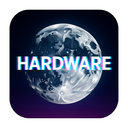
The icon is a meticulously crafted fusion of technology and celestial mystery, where the tangible essence of hardware meets the ethereal glow of the moon while being disrupted by a surreal digital glitch. This intricate design encapsulates a profound narrative about humanity’s relationship with space exploration, technological advancement, and the fragility inherent in our increasingly digital world. At its core stands a stylized representation of a moon—rendered not as an ordinary orb but as an otherworldly celestial body composed of advanced circuitry and microchips. The moon’s surface is textured with fine geometric patterns resembling semiconductor wafers, their lines forming subtle concentric rings that echo both lunar craters and the intricate architecture of silicon-based processors. These patterns are carefully arranged to suggest a harmonious integration between natural form and artificial creation, symbolizing the merging of nature and human engineering in our quest to reach outer space. The moon’s color palette is a mesmerizing blend of cool grays, silvery blues, and faint electric purples—shades that evoke both the vacuum of space and the luminous glow of digital displays. In certain areas, particularly along the terminator line (the boundary between light and dark), there’s a subtle gradient effect that transitions from deep obsidian to radiant silver-blue, mimicking both real moonlight and the shimmering reflection off metallic surfaces in zero gravity. This visual contrast emphasizes the duality of the object: it is simultaneously a natural satellite and a technological construct. The icon’s hardware aspect is most pronounced in its structural design. Embedded within the moon's surface are intricate details that suggest advanced technological infrastructure—microscopic processors, tiny data conduits, and minuscule power nodes arranged in precise arrays. These components resemble real-world integrated circuits but are stylized with a futuristic aesthetic: smooth curves replacing sharp angles, glowing filaments pulsing faintly with energy. Some segments appear slightly raised or textured as if to emphasize their physical presence despite being part of a larger abstract form. What truly sets this icon apart is the deliberate introduction of a digital glitch effect—disrupting the otherwise harmonious balance between moon and machine. Scattered across the surface, particularly near key structural nodes, are bursts of pixelation, vertical scan lines, chromatic aberrations (color fringing), and random data corruption artifacts that resemble corrupted code. These glitches are not haphazard but strategically placed to form dynamic patterns—some resembling ancient runes or fragmented symbols from an unknown digital language. The glitch is rendered in sharp, high-contrast colors: electric magenta, neon cyan, and hot yellow. These vibrant hues clash against the moon’s cool tones, creating visual tension that suggests instability or malfunction. In some areas of the icon, entire sections appear to be flickering—alternating between a clean rendering of the moon and a corrupted version where details dissolve into random noise or pixelated fragments. This effect gives the impression that the moon is not just an object but an active data stream, constantly transmitting information that's being distorted as it travels through space or across digital networks. The glitch isn't merely decorative; it serves a deeper thematic purpose. It symbolizes the inherent vulnerability of digital systems—how even our most advanced technological achievements are susceptible to failure, interference, or external manipulation. In this context, the moon becomes more than a celestial body: it represents humanity’s ambition to colonize space using technology that is still fragile and imperfect. The glitch implies that while we may be reaching for the stars with powerful hardware and complex algorithms, our creations remain vulnerable to corruption—whether from cosmic radiation, software errors, or cyber threats. The icon's overall composition is circular, reinforcing the lunar theme while also evoking the idea of a closed-loop system—a self-contained digital ecosystem. However, subtle breaks in this circle occur where glitches manifest: cracks or gaps in the boundary line suggest data leakage or system instability. These interruptions are not flaws but intentional elements that deepen the narrative. The background of the icon is an infinite starfield composed of faint, pulsating pixels—each one representing a potential signal from deep space. Some stars flicker in sync with the glitch patterns, suggesting that cosmic radiation or unknown signals may be interfering with the moon’s digital systems. This creates a sense of immersion: viewers feel as though they’re observing not just an icon but a living scene from a sci-fi narrative. In terms of scale and usability, the icon maintains high clarity at both small and large sizes—its detailed textures remain visible even when reduced to 16x16 pixels. The contrast between smooth hardware surfaces and disruptive glitch effects ensures readability across digital platforms, making it ideal for use in UI design, app icons, or branding for tech companies focused on aerospace innovation. Ultimately, this icon transcends its visual form. It is a meditation on the convergence of nature and technology—where the moon becomes a symbol of both natural wonder and human engineering. The hardware represents our tools; the moon embodies our dreams; and the digital glitch reminds us that every breakthrough carries with it an element of uncertainty. Together, they form a compelling visual metaphor: humanity’s journey into space is not just physical but also digital, fragile, and perpetually evolving. In a world increasingly defined by data, connectivity, and interstellar ambition, this icon stands as a quiet yet powerful statement: that even in our most advanced creations—our moon-landing modules, quantum computers, and AI systems—there remains an echo of the unpredictable. And perhaps that’s not just a flaw… it’s also what makes progress possible.
Create your own icon with our GoGPT AI prompt:
GoGPT